Steven
E. Runge, High Definition Commentary: Romans
(Bellingham, WA: Lexham Press, 2014), 211-218
Romans 12
Romans 12:1–8
We cannot overestimate the impact our perspective and perception have on our behavior. We talk about misunderstandings and the negative fallout they create, and we work to restore what was broken. But if we step back and think about it a bit more abstractly, such misunderstandings are failures by one or more people to understand each other. Miscommunication and misunderstandings can damage human relationships, and the same is true for our relationship with God. The big difference? With God, we know any misunderstanding is ours, based on our failure to understand Him or to properly act on that understanding.
So how do we avoid the error of wrong thinking? As sinful people, we start with a huge deficit. Our former slavery to sin affected every part of us, just as all of creation has been affected as well (Rom 8:20–23). We could go so far as to say that we were brainwashed by sin. So as we believers await the complete redemption of our bodies on the last day, we undergo a transformational process of sanctification through discipleship. Understood in this way, discipleship is not simply about changing our behavior or learning a few lessons—it requires a complete cognitive makeover.
As we have discussed, one of Paul’s goals in the previous 11 chapters has been to correct misconceptions—not just to create right-thinking but to completely transform how we think. Once we recognize that we have all sinned and are under penalty, Jew and Gentile alike; that we now have peace with God; and that God is sovereignly working out His much-anticipated redemption of the world, the only reasonable response is for us to offer ourselves up in service to Him as a living sacrifice.
We can offer ourselves, but only God can renew our minds and catalyze that wholesale transformation in us. He must both deconstruct our wrong ways of thinking and construct new, correct patterns of thought. The indwelling Holy Spirit enables us to put to death the deeds of the flesh and to be instruments of righteousness for God (Rom 8:12; 6:13).
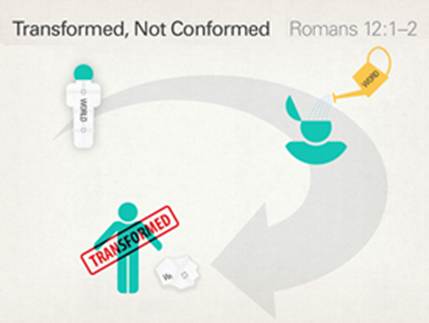
Transformed, Not Conformed: Paul uses the metaphor of transformation to describe the discipleship process. Now that we have been set free from slavery to sin, we no longer need to conform to the patterns of this world. The same Word that brought the transforming message of the gospel will continue that transformation through the renewing of our minds.
The Spirit’s direction of our hearts and minds works in tandem with God’s transformational revelation to us, changing the wrong ideas that led to the wrong behavior in the first place. In Romans 12:2, Paul explains that the natural consequence of allowing God and His Spirit to do this transformative work in our lives is a growing ability to discern and approve God’s will.
As we discussed earlier, PauI’s lack of a personal relationship with the Roman church likely led him to correct them more gently, as we see again in 12:1–2, where he urges and exhorts them to present themselves rather than more directly commanding “Present yourselves to God …!” Paul does not appeal to them on the basis of his authority as an apostle, but on the basis of God’s mercies, making it clear that worship and obedience are the only reasonable response. He could have been much more direct in these commands, as we see in Galatians 1:8–9. Paul changes his discourse style to fit the nature and situation of each church: blunt and direct in Galatians, mitigated and less direct here in Romans.
He continues in this tone into 12:3, transitioning into his next exhortation. Paul appeals to the grace he’s been given as the basis for humility. The key to maintaining this proper perspective is to think sensibly, according to the measure of faith God has provided. Paul uses the analogy of the human body to clarify his meaning: In the same way different parts of our body have different purposes, the same holds true with the body of Christ—the members of the Church.
Let’s be honest: Certain areas of church ministry seem more enticing than other, depending on your personality and gifting. As a result, we may tend to view those more exciting roles as somehow better than the others. But comparison breeds envy—and God didn’t design us to be all the same. In some cases, people in those glamorous roles hold themselves in high esteem and promote the notion that their roles are most important. This stirs up envy and resentment in others, who feel their gifts or ministry don’t get the same level of recognition. It can also cause them to devalue their own gifts—the very ones God entrusted to them for service to the church. Instead of a healthy body working smoothly, as God designed, you have parts working against each other as they try to be something they were never intended to be.
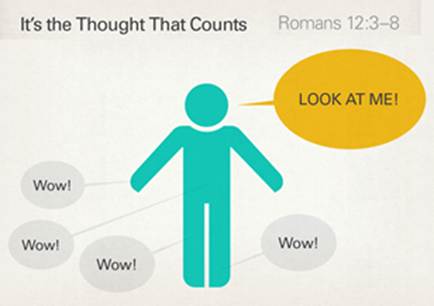
It’s the Thought That Counts: God has given us all unique gifts, but we can easily become distracted when we compare our gifts to those of others. Comparison can cause us to think more highly of ourselves—or more lowly—than we ought. In the end, some may feel like they have nothing to offer because they do not have a certain gift.
The key to preventing this kind of dysfunction is celebrating the importance of each role, whether it is in the spotlight or behind the scenes. Paul reminds us that every part is necessary. If even a few don’t do their part, the body becomes dysfunctional. Notice that this kind of division is not necessarily driven by behavior as much as it is by our thinking. It goes back to that same renewing of our minds—no longer being conformed to the patterns of this world. Paul’s reference in 12:6 to believers having different gifts according to grace is not to point to degrees of grace but to the sovereign administration of grace. Just as the potter can shape the clay as he or she sees fit (9:21), so too can God distribute gifts to His people.
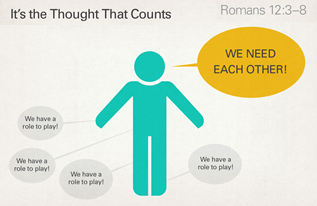
It’s the Thought That Counts: God has given us all unique gifts that support and complement each other in support of the Church. As we each focus on using our gifts, the whole body is able to function as God intended.
Paul reminds us that instead of grumbling about gifts we don’t have or things we can’t do, we should use the gifts we have been given in a way that avoids envy and fighting. We must value the role of each part of the body, not thinking more highly—or more lowly—than we ought. As we keep our eyes focused on the task for which God has redeemed us, the ministry for which He is transforming us, we can uphold the fluid functioning of the body God has sovereignly designed and created.