Steven
E. Runge, High Definition Commentary: Romans
(Bellingham, WA: Lexham Press, 2014), 219-224
Romans 12:9–21
This next section may appear to be nothing more than a long list of random exhortations, but the structure Paul uses in the Greek is very difficult to capture naturally in English. In short, 12:9–13 are one long sentence—just one, with one overarching idea: Love should be genuine. All the rest of the sentence provides practical examples of what authentic love looks like in action.

Authentic Love: We are all commanded to love, but the challenge is to love with pure motives, without any hypocrisy or dishonesty to poison it.
In other words, instead of concentrating on abhorring evil or being fervent in spirit or enduring affliction, the structure of the text portrays all of these as flowing from genuine love. This kind of love is the wellspring, the source out of which all good things flow. Conversely, without authentic love, all efforts to pursue these other things will fail.
Hypocrisy originates in deceitful, dishonest thoughts and actions—whether we want others to think of us more highly, whether we think too highly of ourselves … the list is endless (12:3). When we are motivated by hypocrisy—falsehood and deception—thoughts, motives, behavior, and priorities all get twisted backward. And if we can’t achieve our hypocritical objective, we just pretend to be a better person, enact that perception, and live a lie.
Although I am mocking this type of thinking, I have found myself making such decisions all too often. But why? Because I believe the lie that giving up whatever gives me that (false) sense of security and taking steps to become the honest person I want to be will be too much work—that it won’t be worth the effort. Hypocrisy goes back to the wrong thinking we need God to transform. And if we embrace honest love instead, that which is given purely without expectation of something in return, we will discover the life and blessing God has intended for us. Then the transformation of our minds, renewed by the Holy Spirit, will empower us to embrace needed changes.
Although verses 10–13 are often translated as separate commands in English, they all elaborate on what false love looks like. Paul uses only one command in Greek, followed by a series of elaborating participles. What does honest love look like in action? It turns from the evil that would draw us toward hypocrisy in the first place. It devotes itself to brotherly love and esteeming one another. Instead of lagging in diligence, it is fervent in spirit, serving the Lord and rejoicing in hope. When faced with persecution, it endures and devotes itself to prayer. It contributes to the needs of other believers and offers hospitality.
In 12:14 Paul shifts to another overarching command that continues his theme of our relationships with each other. Generally speaking, these commands focus on esteeming others more than ourselves, in keeping with the exhortation of 12:3. Paul reinforces the command to bless those who persecute you by reframing the statement both positively and negatively.
Why both? My mom gave me a number of “exhortations” while I was growing up. You might be surprised to know that I failed to heed some of these as quickly as I could have. Sometimes I would take a calculated risk, waiting until she had had enough before I fell in line. I knew she had reached her limit when she not only told me what to do, but also what not to do. Paul uses the same strategy in verse 14: To reinforce the command to bless others, he also tells them not to curse others. In 12:20 he commands us to help rather than take vengeance (see also 1 Cor 4:12).

Genuine Love: Love that is pure and without hypocrisy provides the foundation for believers’ thoughts and actions. Our ability to properly treat others flows from this love.
Paul uses the same command-plus-elaboration strategy in 12:15–16, but what we typically translate as commands here are actually elaborations that depend on the command in 12:14. Instead of each one standing alone, they all depend grammatically on the last main verb in verse 14. Each “command” elaborates on what “blessing and not cursing” looks like in practice. The grammar constrains us to identify them closely.
Offering empathy to a persecutor is a variation of esteeming others more than ourselves—even enemies who curse us. Paul calls for empathy rather than hatred for the pain these people may have caused. He extends this theme of empathy through verse 15, rejoicing and weeping and taking part in the circumstances rather than responding with jealousy or anger.
In 12:16 Paul shifts from empathy to like-mindedness; he expounds on this theme in greater detail in Philippians 2:1–4. There, in 2:4 Paul challenges us not to pursue our own interests to the exclusion of others. Being considerate of others’ needs is the key to like-mindedness—but as the word itself implies, everyone must think this way for the idea to succeed. Like-mindedness is a two-way street.
Returning to Romans and the “this not that” structure Paul has established, his call to be like-minded naturally leads to the assumption not to be arrogant or dwell on “arrogant things.” This second idea in Romans 12:16 is generally translated as not being proud, but in Greek the same root word for “thinking” is used in verses 16a and 16b. We get an important insight into Paul’s notion of prideful/arrogant thinking from the action with which he pairs it. We have a “Don’t do A, but do B instead” statement. The corollary to pride and arrogance is associating with the lowly.
Paul’s exhortation may seem as if it is directed at the upper rungs of the social ladder, since it requires there to be “lower” rungs, but this would be reading it too narrowly. The ugly truth is that we can rank people as above us or below us in virtually any context. We can always think of someone who has more than us or less than us, who has a higher position or a lower one. One reason is that our predisposition to sin leads us to think more highly of ourselves than we ought, which means we automatically think of others as being below us. Another reason is that the same sinful inclination also prompts us to look for someone above us whom we can jealously resent for achieving a position to which we aspire. Such thinking is wrong on every level, and yet we all too often fall into these traps.
Paul’s remedy for this sinful predisposition calls for redirecting our primary interest away from ourselves and toward others. This new perspective is the basis for blessing rather than cursing, for the empathy to rejoice or weep with others, and for the ability to be like-minded in our thinking. The same holds true with social conventions and hierarchies, those times when prudence would urge us to avert our gaze, ignore misbehavior, or redirect our path away from it.
Embracing this vision of the gospel, Paul says, will mean embracing its democratizing power far more comprehensively than merely dissolving the distinction between Jew and Gentile. We must also destroy financial, social, and physical distinctions. Unfortunately, a study of Romans typically fixates on the Jew/Gentile distinction without moving on to fully grasp the magnitude and comprehensive power of the gospel to upset all of our sensibilities. God’s ways are not our ways; thus we are under judgment for sin. If we are to respond in faith to God’s free gift of grace and turn from our sinful ways, Paul says we must also abandon the edifices and hierarchies that incarnate sin in our society—easy in theory, but very difficult in practice.
Paul’s next exhortation in 12:16, not to be wise in our own eyes, bears the same relationship with verses 17–20 that we see in verses 9b–13 and 15–16a. This dependence constrains us to understand that the theme of self-confident wisdom unites the secondary ideas that follow. Paul’s first application concerns our response to evil. We are not to repay evil for evil, no matter how just or appealing it might seem from our perspective. Paul provides a positive alternative in 12:18—living at peace with all people, as much as it is possible on our part. Although this technically leaves open the option of war, we are responsible for making peace work until doing so becomes impossible. All too often, we choose to give full vent to our rage and frustration in the name of “not being able to take it any longer.” How much more effort would we put into peacemaking if we saw things from God’s perspective rather than our own?
In 12:19, Paul gives another negative/positive restatement to reinforce the importance of the exhortation. We are not to take revenge ourselves, but we are to leave it to God. This may sound reasonable when we’re calm and there is no crisis at hand, but how many times has our anger driven us to take God’s vengeance into our own hands? Instead of trusting in His superior understanding of the people or circumstances involved, we charge in to “make it right.” But when we step back and think about it for a moment, who knows better what’s right for the situation: us or God?
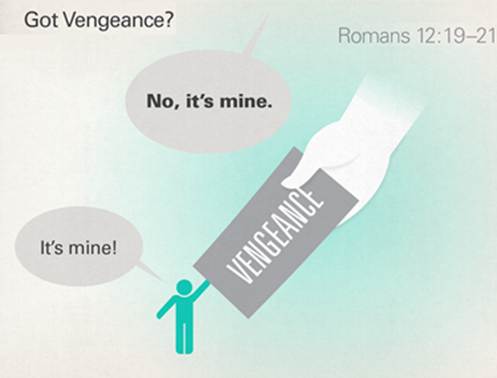
Got Vengeance? When someone does us wrong, our sinful inclination is to want to get even. We might think taking vengeance will be satisfying, but it simply perpetuates the problem. Instead we are to live at peace with those around us and leave vengeance to the one best suited to deal with it.
When we choose to carry out vengeance, we are saying our wisdom is equal to God’s and we are choosing to take that responsibility out of His hands. Does this sound even remotely like a good idea?
Paul supports this call to leave vengeance to the Lord with a quotation from Deuteronomy 32:35 before he moves on in Romans 12:20 to explaining the positive alternative we should choose. When we respond hospitably to those who have wronged us, we leave retribution in God’s hands. Paul says this counterintuitive response has the effect of “heaping burning coals on their head,” referring to Proverbs 25:21–22, where God promises to reward us for not giving into our desire for vengeance.
In the last verse of the Romans 12, Paul provides one more exhortation—one that summarizes and closes this section rather than beginning a new thought. In 12:21 Paul takes the notion of exacting your own revenge instead of leaving it to God and recasts it as being overcome by evil. If we seek to prevent the triumph of evil, we must resist the urge to handle things ourselves and leave them to God.