Steven E. Runge, High
Definition Commentary: Romans
(Bellingham, WA: Lexham Press, 2014), 225–232
Romans 13
Romans 13:1–7
In Romans 13, Paul’s big idea is a touchy subject: submission to authority. Submission can be a tough pill to swallow, especially in a democracy where we champion individuals’ rights to protest or voice ideas. After all, if those in authority were elected by the people, shouldn’t we have a say in what they do or how they do it? Paul provides challenging principles and blunt answers to these kinds of questions, even though there was nothing like an elected democracy in his day.
Paul begins with an exhortation for every person to submit to the governing authorities. To make the point, he structures the Greek to add emphasis to “governing authorities.” Paul’s rationale for obedience has nothing to do with the rulers’ godliness, competence, or any other qualification. Instead, his call for submission to their authority is grounded in God’s authority. The only authorities that exist are the ones whom God has placed there, according to His sovereign plan. Think about that for a minute.
In Paul’s day, many leaders achieved their position through hereditary lineage. A great many others obtained authority based on nepotism and their connections to the intelligentsia. Merit and qualifications often had little to do with it. So if there was ever a time to beg for special exemptions from submission based on rulers’ ungodliness or incompetence, it would have been in Paul’s day rather than ours. We may not like who won an election or the direction the ruling party might take our country, but this does nothing to change the confidence we should have that God is sovereign.
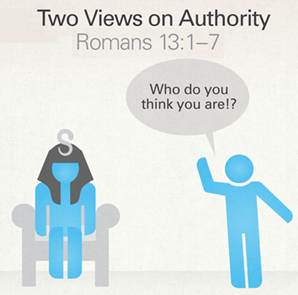
Two Views on Authority: How do you respond to authority figures, especially ones you don’t like or respect? In a modern democracy, where we have had a say in who governs us, we might feel entitled to speak disrespectfully about our government officials. But there are forces at work behind the scenes that challenge this notion.
In practical terms, what does Paul’s theology of divine sovereignty mean when it comes to authorities? Well, if the only ones who rule are those God has placed in authority, then the person unwilling to submit is not just shaking a fist at the ruler, but at God. In Paul’s mind, you cannot separate the one from the other.
The word translated “submit” in most versions is the same one found in Ephesians 5:21 and 24 to describe submission of believers to one another and to Christ. Paul uses the same term in Romans to describe the failure of some to submit themselves to God and His authority (see Rom 8:7; 10:3) or the process by which creation is subjected to the destruction of sin (8:20). In each of these cases Paul makes no hint of merely going along with something grudgingly and under duress. The obedience he describes is respectful and complete.
I know that we have clear examples elsewhere of civil disobedience, even by the apostles themselves in Acts 4:19 (see 4:1–22). How do we reconcile these examples with Paul’s commands in Romans 13? We must resist the urge to view them as mutually exclusive. God placed Annas, Caiaphas, and the other rulers in their positions of authority just as He has with any modern head of state. We have a clear command to submit to their authority based on its origin: God.
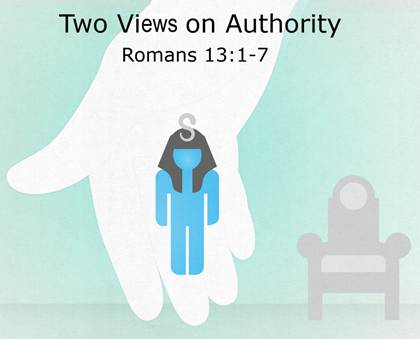
Two Views on Authority: Despite what we might think, God has a hand in appointing ruling authorities. If we really believe in God’s omnipotence and divine sovereignty, Paul reminds us we ought to consider how this theology informs our respect for government officials.
In 13:2b Paul goes on to describe the natural consequences of disobedience: condemnation and judgment. He makes clear in the principles he outlines in 13:3–4 that he is describing those who exercise their authority appropriately, punishing evil and rewarding good. So if we want to avoid living in fear of authority, then obedience and pursuit of good should lead to praise (13:3).
Once we understand the divine intention for these authorities, we have a basis for reconciling the apparent contradiction between submitting to God-ordained authorities while still honoring God. God invests people with authority, but that does not guarantee they will exercise it as He intended. We have already examined the case of Pharaoh, king of Egypt. God Himself placed Pharaoh in authority and used Pharaoh’s disobedience to make His own power known (9:17).
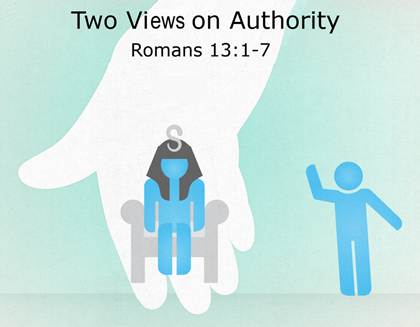
Two Views on Authority: If God has indeed appointed those in authority over us, there are important ramifications. If we choose to resist these authorities, we are at the same time choosing to resist God.
Paul urges submission to authority based on the divine origins of that authority rather than the rulers’ capabilities or godliness. He pictures the authorities here as obedient, just as they are in Titus 3:1 or 1 Peter 2:13–14. If they exercise authority properly, then our submission should lead to a positive relationship. Although Paul is silent regarding unjust rulers, Peter is not. Peter describes an example of subjecting oneself to a master even if he is unjust (1 Pet 2:18–19). He takes the position that even in the face of unjust authority, it is still better to submit and suffer than to rebel. He offers Jesus as an example of suffering unjust judgment (1 Pet 2:21–24), that we might follow in His steps.
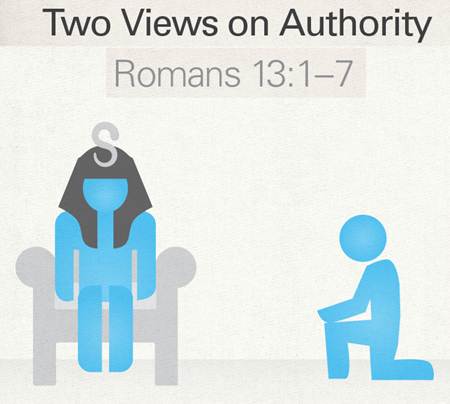
Two Views on Authority: Whether we like or respect a leader, voted for them or not, our response should be the same. If we believe that God is sovereign, then this belief requires that we respect those in authority over us. If we choose to resist them, then we have reason to fear—we are resisting God as well.
If we distilled Paul and Peter’s teaching about authority from Romans 13 and 1 Peter 2:21–24 into basic rules of engagement, here’s what we would get:
1. Honor God above all else, even human institutions.
2. Submit to authority, since it is placed there by God.
3. When it is not possible to do both, then expect to suffer for honoring God over human authority.
We see a practical example of this theology in the American Civil Rights movement of the 1950s–60s. Civil disobedience drew attention to the injustice, and many suffered dreadful consequences for protesting the inequality of segregation and Jim Crow laws. Most, but certainly not all, of these protesters chose respectful non-violence to bring about needed change. Unfortunately, what we see most often among Christians today is an appeal to the examples of civil disobedience in Scripture without a balancing commitment to the clear and repeated commands in Scripture to submit to authority. We cannot cling to one principle while denying the other.
In 13:5 Paul provides another reason for submission to authority: having a clear conscience before God. Conscience is not just the basis for submission, but also for paying the taxes due to the authorities (13:6). We owe these taxes because the leaders are God’s servants, and their governing is characterized as a service to God. Think about that for a minute. Paul’s statement places these governing servants in the same realm as God’s other servants: priests (Num 18:21, 24) and vocational ministers (1 Cor 9:7–12). Taxes allow them to serve, much like the tithes and offerings received by those in ministry. This can be a frightening thought, but all the more reason to honor them as God’s sovereignly appointed servants, fulfilling His divine plan even when we might not see how.
In 13:7 Paul sums up and closes this section, but he moves beyond monetary issues like taxes and duties to what can seem even more costly: respect and honor. He declares that God is far more concerned with our inward attitude than our outward, potentially hypocritical, compliance. Just as our love for others must be authentic—regardless of whether they are friend or foe—the same holds true for our submission, honor, and respect for the authorities God has placed over us.
Top