Steven
E. Runge, High Definition Commentary: Romans
(Bellingham, WA: Lexham Press, 2014), 233-238
Romans 13:8–14
Continuing from the payment theme in verses 6–7, Paul adds love as yet another thing we owe others. Taxes, duties, honor, and respect can be paid in full, but love cannot be measured, whether in giving or withholding. Paul portrays love as an ongoing obligation, one that can never be fully paid.
In the second half of verse 8, Paul equates loving someone with fulfilling the law. But wait—the righteous requirements of the law were fulfilled in us as a result of Christ’s triumph over sin through His death and resurrection. True, and Paul is not saying otherwise here. He has already declared that there is no other path (Rom 3:20; Gal 2:16).
In two letters—Romans and Galatians—Paul equates loving others with fulfilling the law. In the first half of each letter, Paul focuses on correcting misconceptions about how a person obtains a righteous standing before God and declaring what must be done. Paul is not changing what he previously argued. Instead, he is elevating the value of loving one another to a much higher position: equal to fulfilling the law. Paul could not have created a better analogy to explain the importance of love to his Jewish audience. The other passage, in Galatians 5:14, achieves the same purpose: “For the whole law is fulfilled in one statement, namely, ‘You shall love your neighbor as yourself’ ” (leb).

Debt of Love: We should always pay what we owe, but we will never be able to fully pay one debt: love. Paul uses the analogy of debt to describe how we ought to regard love for others. We should not expect that the need for us to love others will ever be fulfilled.
By assigning love for one another with such a high value—equating it with fulfilling the law—Paul emphasizes the importance of this command. We find a similar argument in James 2:8, where James says we fulfill the royal law when we love our neighbor as ourselves. Mark 12:29–31 presents Jesus’ answer to the question about which is the greatest commandment. Instead of providing only one command, Jesus answers with two: loving God with all your soul, mind, and strength, and loving your neighbor as yourself. “There is no greater commandment than these,” He says.
It’s easy to let our priorities fall out of sync with God’s. Circumstances often cause us to focus our priorities on right doctrine or spiritual gifts. But by promoting loving one another (and loving God) as the highest calling for a Christian, Paul reminds us that following this command enables everything to function in God’s order. This is the tack Paul takes in 1 Corinthians 13, examining what otherwise good things would be like if love was missing.
Although it may seem that Paul is changing his tune about our human ability to fulfill the law, it is best to understand his claim in verse 8 as signifying the importance of love above all else. He strengthens this claim in verse 9 with another bold assertion: Many other commandments are essentially entailed within the command to love one another. If we make loving others our singular goal, we will easily avoid committing murder, stealing and coveting, since “love does not commit evil against a neighbor” (13:10).
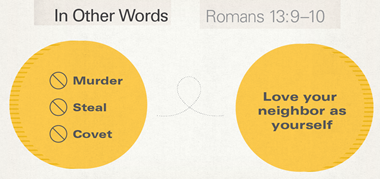
In Other Words: Paul compares the commandments against adultery, murder, theft, and coveting with the command to love our neighbor as our self. The one summarizes the others; they are two sides of the same coin.
In the Boy Scouts, our leaders continually stressed the importance of being prepared. I addressed this at first by packing everything—including the kitchen sink—so I would be prepared for camping or backpacking. Sure, I was prepared, bringing along a zillion implements, but I was weighted down by a very heavy pack. Over time I learned to prioritize—a single piece of gear, like a Swiss army knife, would equip me for any number of circumstances. The same holds true for our Christian walk. We could memorize and attempt to follow countless commandments, but we could also focus our attention on loving one another. If this one commandment is truly as game-changing as Jesus, Paul, and James say it is, we would be foolish to do anything other than give it our full attention.
Rather than introducing another big idea, Paul uses the balance of the chapter to build motivation for pursuing love. He draws on the same type of metaphors he uses in Romans 7:21–8:2, contrasting our former life enslaved to sin with our new life as children of God. But instead of the imagery presenting the contrast as death versus life, in 14:11–14 he presents his concepts in terms of sleeping versus being awake, and darkness versus light. Paul frames things as if there was a time when, figuratively speaking, it was appropriate to sleep, and he connects this spiritual sleep with the spiritual death we experienced while we were slaves to sin. We were bound to slavery and death—we had no other choice.
But now as redeemed believers, set free from bondage to sin and death (8:2), Paul says sleeping is no longer an option. In fact, in verse 11, he uses “already/now” to describe the time we should wake up, as if we have overslept. The time to leave behind our old ways is not coming—it is here!
How can we know that we overslept? Because, Paul says, the day of our salvation is nearer than when we first believed (13:11b). Here we must consider what Paul means by salvation. The mention of when we believed is a clear reference to confessing with our mouth and believing in our hearts that Jesus is Lord (10:9–13). Yet Paul clearly has in mind a day of salvation that has not arrived, but that is closer. This not-yet salvation refers back to the discussion in Romans 8:18–25. In 8:23, Paul declares that even though we have the firstfruits of the Spirit—a reborn inner person and the indwelling of the Holy Spirit—we still “groan within ourselves while we await eagerly our adoption, the redemption of our body” (leb).
In the very next sentence, 8:24, Paul reminds us that “we were saved in hope,” meaning the salvation process is not yet complete. Although our inner person has been renewed, the outer is still awaiting that final redemption along with the rest of creation.
In Romans 13:11–14 Paul gives us a wake-up call for this “in the meantime” stage of God’s plan. Having been set free from sin, we no longer have any excuse for sleeping on the job, so to speak. God has provided us with everything we need to carry out His purposes for us. The big question is whether we will arise and pursue that which Christ took hold of for us (Phil 3:12). The night has passed and the day has arrived, a situation Paul says calls for a response, which he describes in the second half of 14:12.
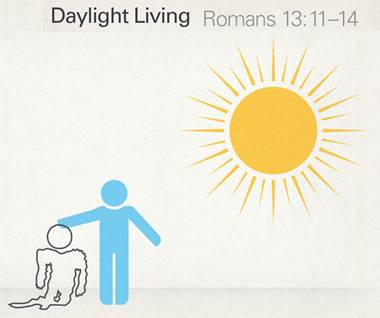
Daylight Living: Sinful activities often take place in night and/or darkness, perhaps based on the notion that we can hide our sin. Paul uses this contrast between things done in darkness versus things done in the light to challenge us regarding our former sinful behavior. Daylight living, as Paul describes it, means laying aside the old sinful patterns and putting on the Lord Jesus Christ instead.
The deeds of darkness are those things our sinful flesh tempts us to do. Having been set free from sin, Paul says we must exchange these remnants of our old, dark selves for the armor of light God has provided for us. In 13:13, he clarifies the reason for this shift in imagery to dark/light and night/day. We are called to decent living, the kind of behavior associated with daylight hours instead of what is typically done under the cover of night. This imagery ties back thematically to 12:9 and Paul’s prohibition against inauthentic love. The same genuine nature should characterize our actions. Just as Paul questions in 6:21 the type of fruit we produced from the behaviors of which we are now ashamed—dark activities such as carousing, drunkenness, and sexual immorality—he now emphasizes the shamefulness of continuing to walk in sin.
Living one way in the full light of day and another in the cover of night is not, Paul says, what God intends for us. We must throw off dark deeds by putting on the Lord Jesus Christ. As we do this, we simultaneously avoid giving any ground to sinful desires (see Rom 8:5–8). Paul goes even further in Ephesians 5:7–11, when he uses this same darkness versus light metaphor. Paul bluntly tells the Ephesians that they, and we, should do more than avoid dark deeds; we are to expose them and bring them to light.
The call to genuine love extends far beyond our love for other people; it must include our love for God. We have been redeemed for a purpose: living a new life as instruments of God’s righteousness. But if we continue to indulge in our old sinful ways to any extent—even if no one else sees us—we undermine our ability to serve as the tools of righteousness God intended us to be.