Steven
E. Runge, High Definition Commentary: Romans
(Bellingham, WA: Lexham Press, 2014), 247–252.
Romans 14:13–23
Paul’s big idea of the preceding section is receiving those who were weak—without judging or despising them. In this section, he shifts his focus from receiving to judging. He also shifts from the specific matter of judging a weaker believer to a more general focus on judging one another without taking faith into consideration. In 14:13 Paul provides a negative and a positive exhortation. This pairing gives us insight into his specific concerns.
His negative prohibition is the same as in 14:3, exhorting believers not to judge others. Paul repeats the same Greek root word used in this part about not judging others in a second exhortation in 14:13. However, the parallelism is lost in translation, since the object in the first exhortation is a person, whereas the object in the second is a thing that we purpose or decide to do. In the second exhortation, Paul also includes a rhetorical device, a forward-pointing reference to draw attention to this new idea even though he uses the same verb in both. At the end of verse 13, he uses “this” to point ahead to something we are not to do: We are not to be or to place a stumbling block or temptation before a fellow believer.
In the first part of the chapter, Paul portrays judging as a hindrance to fully receiving believers into fellowship. Here the repercussions are much more severe. Paul uses the same term Jesus uses in Luke 17:1–2 as a dire warning to those who are a stumbling block or trap for others. The Lord declares it would be better to have a millstone tied on one’s neck and be thrown into the sea than to cause another to stumble. Thus, Paul moves beyond the call to leave judgment to God and points to the direct condemnation of this behavior.
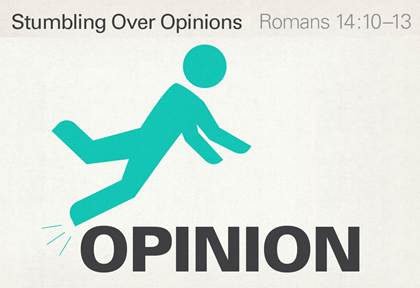
Stumbling over Opinions: When we hold different opinions, we can easily place more value on our own ideas than on those held by the person with whom we disagree. Instead of judging or despising those with whom we differ, we need be wary not to cause them to stumble and keep in mind that we will all give an accounting before God for our actions.
Paul lays down a principle in 14:14 as if it represents conventional wisdom with which all of his readers should be familiar and that all would accept. Paul structures his argument as an untrue statement, until you reach the caveat at the end. Some things are unclean in and of themselves, but the basis for this determination is not some external, objective criteria. Instead the basis is an individual’s conscience before God. This principle restricts my personal rights and freedoms and links the exercise of my freedom in Christ to its impact on believers around me.
Although I may have the faith to do something in clear conscience, there is another factor I must take into consideration. In Christ there is nothing unclean in and of itself. However, if a member of our fellowship believes his or her conscience forbids eating this or drinking that, everyone in our fellowship is called to place a higher value on not negatively impacting that brother or sister than on exercising our own freedom.
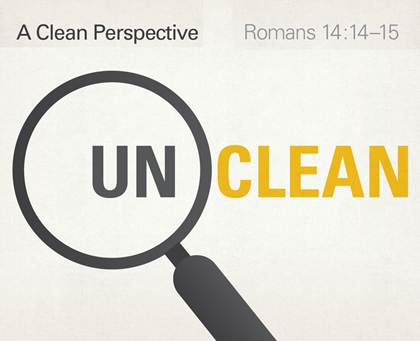
A Clean Perspective: In Christ nothing is considered unclean in and of itself. However, this does not mean that everything is considered clean by all believers. If someone’s conscience leads them to consider something unclean, then it is unclean for them. In such cases, we need to be careful that our exercise of freedom does not grieve or cause believers to stumble.
Paul reminds us in verse 15 what the Christian life is really about. We have been set free from bondage to sin so we are able to love others as God has always intended, based on His Spirit’s work in our lives. But if we place a higher value on our eating and drinking than on our love for others, what kind of faith is that? How strong is my faith if I put my own interests first?
Jesus had already declared that nothing is inherently unclean (Mark 7:14–23). The Spirit impressed the same lesson on Peter in Acts 10:9–33, in anticipation of Gentile believers receiving the Holy Spirit in the same manner as the apostles—without the laying on of hands. These passages outline one-half of the equation—that there is no person or food that can somehow harm our standing with God. But Paul provides a balancing principle in Romans 14 that restricts the extent to which this freedom can be enjoyed.
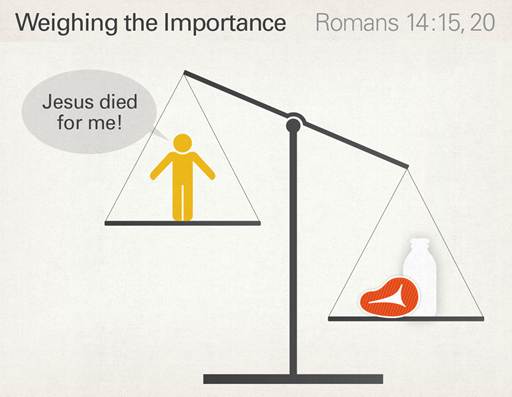
Weighing the Importance: While it is true that we have freedom in Christ, that freedom was given to enable us to fully serve God, not our appetites. If we love exercising our freedom more than we love our fellow believer, then what is the point?
Paul frames the issue to highlight what our decisions say about our priorities. In 14:15, he poignantly highlights the issues at stake. Do we really place a higher priority on the food we eat than on how our eating habits may affect fellow believers? If so, then Paul says we are choosing to destroy a person—a person for whom Christ died—for the sake of exercising our freedom. In 14:17 he introduces things that should tilt the scales in favor of strong faith: righteousness, peace, and joy.
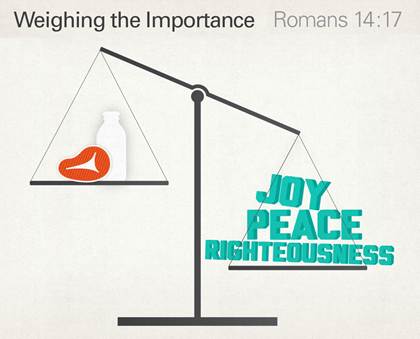
Weighing the Importance: Although all things are clean, nothing is important enough to cause another believer to stumble. If we place greater value on food than on people, then we are no longer living in according to love.
Freedom from dietary restrictions for the sake of religious purity opens the door for us to enjoy most anything God has created. Furthermore, our country’s laws also guarantee certain rights and freedoms. Nevertheless, believers face a higher calling: placing the needs of others before their own. If we focus on our freedoms at the expense of others, Paul says in verse 16 that we run the risk of undermining any positive testimony of our faith. He counters this negative picture with a positive one in verse 18. Honoring others serves Christ, which wins God’s pleasure and people’s approval. No food or freedom is worth these.
In the final paragraph of the chapter, Paul introduces closing exhortations that are logical consequences of his earlier remarks. The exhortation to pursue behavior that brings peace and edification provides a positive corollary to the prohibitions against judging and despising fellow believers for their stand on debatable matters (14:19). Paul supports this corollary in verse 20, where he reiterates that the pursuit of Christian freedom at another believer’s expense destroys the work of God for the sake of food.
So although there is freedom in Christ, its effect on others becomes a very practical limit on that freedom. In 14:21 Paul shows us what this looks like in practice: Since it is better to abstain from what is permitted than to offend, weaken, or cause another to stumble, having the stronger faith cuts both ways. Although it might enable me to eat or drink things others could not, it also obligates me to willingly opt out of partaking in what is permissible for me. In 1 Corinthians 6:12–13, Paul describes the same principle in a slightly different way. All things may be permissible, but they may also be unprofitable based on how my actions affect others. This principle now overrides specific rules and laws for judgments about Christian liberty. Unfortunately, principles are hazier than rules, and they can vary from context to context. These factors demand us to be both vigilant and considerate.
The final verse is one that has caused me trouble over the years. This is a natural consequence of it being a principle instead of a rule. When I was a new believer, I knew there were things I should abstain from based on the negative impact they had on me before. But over time, as I gained more self-control and maturity, I began reconsidering whether it was really necessary to give up those things. I saw other believers doing them, and most of them had been following Jesus for a lot longer than I had. If all things are lawful and permissible, why shouldn’t I enjoy the same kind of freedom as the others? Here is where conscience comes in. It is not a matter of needing more faith to do something less advisable; it is a matter of how God has wired each of us. Some are able to do something without any twinge of conscience, without any doubt about its permissibility. Others, like me, know the doubts and questions in my heart that will condemn me. So if I choose to partake in something on the basis of seeing others do so, then for me it is not an exercise of faith, but an exercise in sin. And having been set free from bondage to sin, I have no desire to reclaim it in the name of “freedom.”