Steven
E. Runge, High Definition Commentary: Romans
(Bellingham, WA: Lexham Press, 2014), 253–261.
Romans 15
Romans 15:1–13
In this next chapter, Paul continues his discussion contrasting how the weak and strong are to treat one another. He no longer mentions the basis for the distinction—like eating, drinking, or observing special days. Paul has given more than enough examples of things that might cause tension in the Christian community. These principles may have derived from disputes over foods or holidays, but they apply much more broadly. Thus, in this section, the breadth of application for Paul’s exhortations has no stated bounds.
In Romans 14:1, he exhorts us to accept the weaker believer without quarreling over debatable matters. He follows with commands not to judge or despise others for the exercise of their faith, be it weak or strong (14:3, 13). He also gives commands not to destroy or tear others down based on what they do or do not do (14:17, 20). God has accepted them, which is the only criterion for us to accept them as well (14:3).
Paul’s exhortations in this section shift away from a focus on corrective prohibitions to positive corollaries that should guide our judgments on these matters. In 15:1, he calls us to do two things: to bear with the weaknesses of the weak, and not to please ourselves. Pairing these two actions suggests that bearing with one another’s weaknesses will not be all fun and games. Instead, it may mean abstaining from pleasurable and otherwise permissible things for the sole purpose of helping a weaker believer.
In 15:2, Paul discusses shifting our goal from pleasing ourselves to pleasing others for their good and for the purpose of their edification. Paul is not calling us all to let other believers take advantage of us. He gives us qualifications that tell us that the basis for pleasing them is what is in their best interest—things that would lead to their edification. These qualifiers serve as a safeguard. Paul holds Christ Jesus up in verse 3 as our model of one who made the ultimate choice to edify others over pleasing Himself. We find a parallel picture in Ephesians 5:25–26, where Paul portrays Christ’s sacrifice for the church as based on the goal of sanctifying and cleansing it—the very type of edification he is commanding here.
If we pause to think about weak and strong, we realize Paul has never explicitly labeled either the Gentiles or the Jews with these terms. He has referred to issues of conscience that might be a matter of derision for either group, but he wisely opted not to use labels. By being less specific about whom he has in mind as weak or strong, Paul can more broadly apply his principles.
Think back to our discussion of the human tendency to think more highly of ourselves than we should. Most of us would prefer to consider ourselves strong in faith. Instead Paul declares that strength does not entitle us to pursue our freedoms—it obligates us to use this strength for the edification of others, even to our own hurt and at the sacrifice of our own pleasure.
How does all of this relate to the church in Rome? If those who believe their faith is strong have been causing dissention by accepting weaker brothers for the purpose of correcting, judging, or despising them, then Paul’s exhortations have turned the tables on them. Although they might identify themselves as strong, their self-centered and judgmental behavior toward other believers will reveal their hypocrisy.
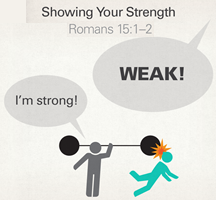
Showing Your Strength: What makes us strong, the ability to act or the discipline not to act? We may have the strength of faith to do something with a clear conscience, but Paul provides another consideration we must take into account.
As Paul declares in 6:1, God did not give us strong faith so we could fulfill our own desires any more than He set us free from sin so that we could continue sinning. He gave us freedom and spiritual gifts so that we could be instruments of His righteousness (6:13) for the building up of fellow believers. Paul sees this self-centered, self-serving view of strong faith as “conformist” thinking that must be transformed by the renewing of our minds (12:3). Such faith will not impress God. Paul says believers focused on their own pleasure at the expense of edifying those around them are themselves weak and in need of edification.
The way Paul structures this section, including his lack of identification of the weak and the strong, allows him to extend these principles far beyond dietary laws or calendars. They present an aspirational description of a strong believer.
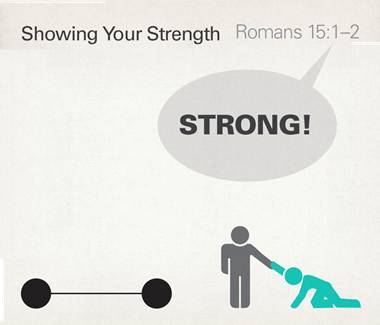
Showing Your Strength: Those who consider themselves strong demonstrate their strength by bearing with the weaknesses of the weak—not by exercising their freedom in Christ without consideration for others. From Paul’s perspective, strength is shown by pleasing our neighbor instead of ourselves.
If we claim to be strong and yet fail to edify those around us, our actions belie our words. To receive God’s affirmation of our faith—and that of believers around us—we must bear with the weaknesses of others and seek their edification rather than seeking our own pleasure.
We already learned that bearing with the weaknesses of others will likely entail unpleasantness, and Jesus’ experience confirms this. God never promised a faithful life would be easy. Quite often the opposite turns out to be the case—thus we are called to patient endurance. And for those discouraging times when we wonder if our efforts are worth the cost, Paul reminds us in verse 4 that Scripture serves as the foundation of our encouragement. We cannot rely on our reasoning or experience alone.
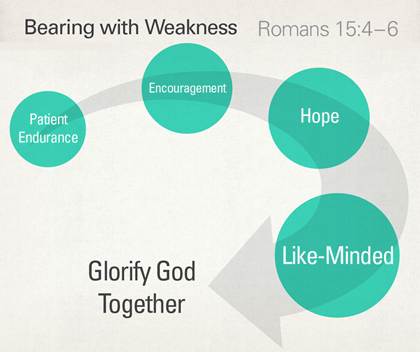
Bearing with Weakness: Paul ties together several seemingly unrelated things to show the role each plays in achieving a larger goal.
When we choose to rely on the promises of Scripture, instead of our own understanding, as the foundation for our decisions, we find encouragement and increased hope that God is indeed working all things together for the good of those who love Him and are called according to His purpose (8:28).
Paul affirms this idea by essentially renaming God in 15:5. By calling Him the God of patient endurance and encouragement, Paul is not narrowing our view of God—just the opposite. This thematically loaded expression casts Him in a very specific light, shaping our confidence in His character and motivating us to live in agreement with one another, as God desires us to do (see 12:18).
This progression leads to the fulfillment of many goals: As we seek to edify others through patient endurance, we find encouragement in Scripture, which leads us to greater hope and a sense of like-mindedness for all involved. These attitudes, in turn, lead to the end of judging and despising others—and ultimately to believers standing together, glorifying God as one body. Whatever discouragements we may face as we seek to edify others, we cannot allow those pitfalls to undermine our confidence in the joy that comes from obeying God’s commands. In 15:7 Paul summarizes this call to look to Christ as our model for sacrificing for each other, with the ultimate goal of glorifying God.
As we progress through the chapter, we see Paul returning to his opening themes. Recall from the “Structure of Romans” section that Paul repeatedly digresses from the stated objective of the letter: announcing his intention to visit the church in Rome. His primary goal, of course, is to use these digressions to address key issues he intends to cover—but to do so less directly and thus avoid potentially alienating his audience. His exposition of the gospel, solidly grounded in both the Old Testament and a common-sense understanding of humanity’s fallen state, establishes his rapport with this church he has likely never visited.
Paul describes God’s plan of redemption as having natural consequences. Christ’s death and resurrection atone for the consequences of sin. Creation should respond by patiently awaiting the final redemption that is coming (8:20–23). Likewise, as those who have received the gospel message await final redemption, they should give up their attempt to conform to this age, instead being transformed through the renewing of their minds (12:3). Freedom from slavery to sin demands us to respond by leading our lives in a manner worthy of the gospel of Christ (Phil 1:27).
As we know, Paul has other reasons for writing. Here he begins to tie the strings of his argument together as he refers to specific implications of points he raised earlier in the letter. The remainder of this section acts as a hinge, connecting his exposition and exhortations to his specific apostolic calling to reach Gentiles—from Jerusalem to the northern reaches of the Roman Empire, namely Spain.
In 15:8–12 Paul once again digresses, in this case to strengthen his assertion in verse 7. He makes two points about Christ—one concerning Jews, one Gentiles. He grounds his call to accept one another in Christ’s acceptance of us, but then he segues from believers accepting one another within the church to Christ’s ministry to those outside the church. Christ came to the “lost sheep of the house of Israel” (Matt 15:24), as servant of the circumcision (see Rom 15:8), confirming God’s promises to the patriarchs. At the same time Christ also came to open the way for Gentile believers to glorify God—an outcome expected from the patriarchal promises.
In connecting the Gentile mission to God’s promises to Israel, Paul prepares his audience to shift gears with him, from exposition of the gospel to his hopes for spreading the gospel, in verse 14. He has just finished making the case that Jew and Gentile alike are under judgment for sin and need to respond in faith to God’s righteousness as revealed in Christ Jesus. In Romans 9–11, he highlights some important realities: The hardening of a portion of Israel to God’s message of salvation provides a window of opportunity for the Gentiles (11:25). The Gentiles’ response to the gospel will provoke jealousy in some of Paul’s countrymen. Thus by following his calling as apostle to the Gentiles, Paul has helped reach both Jews and Gentiles with the gospel (11:13–14).
In 15:9b–12, Paul quotes the Old Testament to demonstrate broader application of his claim that there is no distinction between Jew and Gentile. The quotations remind us that God’s plan is intended for all of humanity—that was His goal from the very beginning. The covenant was never intended to shut some out; it was meant instead as the means to bring them in. The one in whom all—both Jews and Gentiles—could put their hope would come from Israel (Rom 15:12 from Isa 11:10). In Romans 15:13, Paul provides a benediction for this section, painting a complementary portrait of God as the God of hope (compare with 15:5) and reinforcing the themes of hope and encouragement we find as we seek to edify others. The key to abounding in hope, Paul says, is being filled with joy and peace made possible by the power of the Holy Spirit (see 8:26–30).