Steven
E. Runge, High Definition Commentary: Romans
(Bellingham, WA: Lexham Press, 2014), 263–267.
Romans 15:14–21
Paul tackles a wide range of topics in this letter, many of which may have seemed like new information to his readers. The same likely holds true for many of us as well. I have known for years that God promised to bless all the nations through Abraham (Gen 12:2–3). I have also read the many Old Testament promises to Israel about a remnant being preserved (as in Isa 10:22–23) or of God restoring His relationship with His people (Hos 1:10). But I never reconciled all of this divergent information into a unified picture of God’s plan for humanity. This complex letter is filled with details!
Paul presents us with a holistic view of many (not all) pieces of the puzzle, showing us how they all fit into the larger plan. Although it’s good to have our incorrect or incomplete notions set straight, such revelations can lead to unintended consequences. Faced with bigger changes and corrections, we can feel unsettled and lose some of our confidence in what we know. If I was wrong about all these things, how many other things about God and His plan have I misunderstood?
In this section, Paul provides some much-needed reassurance for his shaken readers. In 15:14, his declaration that he is fully convinced grabs his readers’ attention and spotlights what it is he’s convinced about. The “I myself” statement fulfills the same attention-getting role, interrupting the flow of the sentence in Greek. Paul uses a device I call “thematic addition” to connect the “you yourselves” back to the preceding context. Thus far, Paul has demonstrated his knowledge and goodness to the Roman believers, along with his ability to instruct them. The sentence about his full confidence draws attention to his assurance that they too are filled with goodness and all knowledge, and that they too are able to instruct one another. In other words, as much as his instruction—filling in gaps of knowledge or correcting misinformation—may have shaken their confidence in their knowledge of God, they should trust that God will use their knowledge and their goodwill toward one another to keep moving forward. They should not stand still and wait for his next letter to tell them what to think and do.
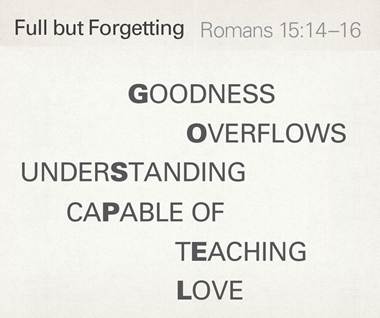
Full but Forgetting: The Romans, like us, may hold to a number of facts about God and His plan for humanity, but they may still need to sort them into a unified picture of the whole.
Paul acknowledges in verse 15 that he has been quite blunt in delivering his message, but that his purpose in writing has been to remind them of things they should have already known. Now, with this deeper understanding of the gospel and God’s intention for it, they should be filled with confidence that God will continue to lead them forward.
Paul justifies his direct approach, not on the basis of his apostolic authority, but on the measure of grace God has given him. God extended His grace to Paul so that he could serve as a minister of Jesus Christ to reach the Gentiles with the gospel. Paul’s goal is to lift up those who believe as an offering to God, like the one described in 12:1.
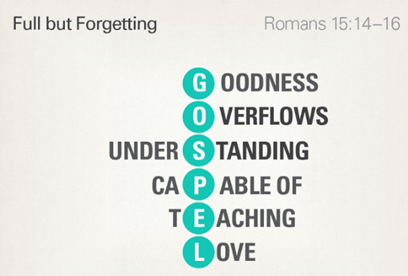
Full but Forgetting: In Paul’s exposition of the gospel, he has taken seemingly unrelated facts and ideas from Scripture and shown how they all fit together into a unified plan for redeeming all of God’s creation. Instead of presenting this as a brand new plan, Paul demonstrates the gospel has been God’s plan from the beginning.
In 15:17, Paul closes with confidence in God’s ability to bring about His plans. He spotlights God in verse 18 as the one who will accomplish these plans and declares that he will speak of nothing but what Christ has accomplished through him in leading the Gentiles to obedience to God. Paul can confidently boast that he has fully proclaimed the gospel from Jerusalem to Illyricum, attesting God’s faithfulness in every city and town. His declaration raises an obvious question: What’s next for Paul?
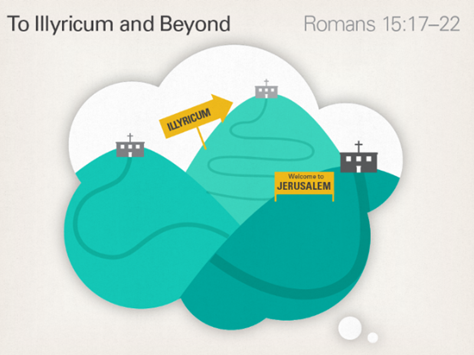
To Illyricum and Beyond: By describing how fully he has preached the gospel in Jerusalem, Illyricum, and the surrounding areas, Paul paves the way for mentioning his intent to take the gospel to Spain.
But before discussing his next geographic objective, Paul outlines in 15:20 the principle that guides his ministry of proclaiming the gospel: He preaches where Christ has not yet been named. Paul feels called to establish new congregations in areas the gospel has not yet reached, not for his own glory but for the spreading of the gospel. We know that he didn’t simply plant a church and walk away. As he says in Acts 15:36, he desires to visit and encourage the churches he and Barnabas planted. Nor has he been seeking to avoid addressing problems another preacher left behind: His letters to the Galatians and the Corinthians make clear that churches Paul planted are not immune to problems or dissention.
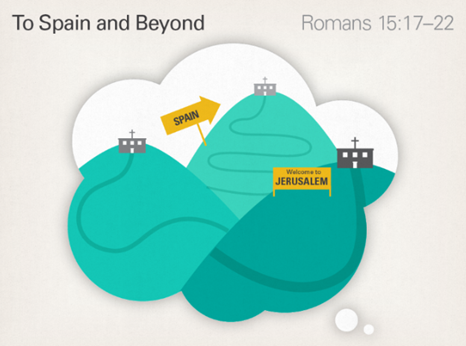
To Spain and Beyond: After fully preaching the gospel in Palestine and Asia, Paul felt called to preach where others had not yet gone: Spain. Part of Paul’s desire to visit the church in Rome is his hope that they would support his mission efforts to Spain.
But having begun a new work in a place, Paul would train up leaders before moving on to new territory. His letters to Titus and Timothy illustrate how he delegated some of his leadership tasks, such as appointing qualified elders and ensuring sound doctrine was being taught (Titus 1:5; 1 Tim 1:3–4).
Paul bolsters his calling to boldly proclaim the gospel where it had not yet been heard by citing a passage from Isa 52:15 in which the Suffering Servant has been exalted and lifted up, his influence reaching many nations. Through this revelation of the Lord, kings are silenced because they have seen something they were never told, and they understand what they had not heard. Paul quotes this passage to present the image of the gospel—a new message—being revealed to and understood by a new audience.