Steven
E. Runge, High Definition Commentary: Romans
(Bellingham, WA: Lexham Press, 2014), 269–270.
Romans 15:22–33
As Paul explains his faithful proclamation of the gospel from Jerusalem to Illyricum and his call to preach where others have not, he sets the stage for circling back to the beginning of his letter: his stated intention to visit Rome. Remember how Paul opens his letter, describing his desire to come and visit the believers in Rome? Now, however, he discloses in greater detail exactly what is bringing him to Rome. He has something more in mind than just mutual encouragement and edification. The great city is a stopover on a much longer missionary journey to unreached parts of the known world.
In Romans 1:10, Paul tells us he hopes to succeed “at last” in visiting the church in Rome. He picks up this same idea in 15:22, where we learn that Paul has been hindered many times from visiting. One of the reasons he wishes to travel now is that he is looking for new places to preach the gospel. In 15:24, Paul states another reason for visiting: his hope that the Roman church will support him in going to Spain. But before he can visit, he must deliver the offering from Gentile believers in Macedonia and Achaia to the poor believers in Jerusalem.
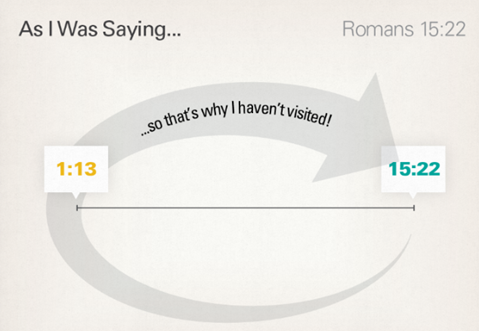
As I Was Saying: The letter to the Romans began with a clearly stated purpose: Paul’s desire to visit the church in Rome. But Paul carefully structured his letter around this formal purpose so he could go on to address important issues regarding how these believers understood the gospel. Finished with his exposition of the gospel and all its implications, Paul resumes the formal purpose of the letter by reiterating his desire to visit.
Why does Paul mention the Gentile origins of the gift? He is offering a practical implication of the principle outlined in 11:17–18. Since the Gentiles have shared in the spiritual blessings bestowed on them through Israel, they ought to share their financial blessings with the believers in Jerusalem (15:27). Why does Paul mention this offering here? By providing a rationale for believers in one area to financially support believers elsewhere, based on their shared spiritual bond in Christ, it would be natural for the Roman believers to practice this principle by sending Paul on his way to Spain with their own gift of support.
Paul closes this section by exhorting the Romans to pray on his behalf, that he would be rescued from “those who are disobedient” in Judaea, and that the offering he is delivering to Jerusalem would be acceptable to the saints (15:30–31). “The disobedient ones” may be a cryptic reference to Jews who oppose Paul’s proclamation of the gospel. Remember from Romans 11:28 that although the Jews are loved based on God’s promises, their opposition to the gospel makes them seem like enemies. Paul requests prayer for a safe and successful completion of his mission to Jerusalem so that he might come to Rome and rest (15:30).