Steven
E. Runge, High Definition Commentary: Romans
(Bellingham, WA: Lexham Press, 2014), 271–292.
Romans 16
Romans 16:1–16
As we reach the end of Romans, we hit that dreaded part of the book: the personal greetings. Paul has finished his theological exposition, with his eminently preachable corrections and exhortations. Suddenly we feel like eavesdroppers, as he extends personal greetings to people we know nothing about except for their names. What is there to learn from Paul’s mention of them in this passage? Perhaps a lot more than you might think.
At face value, it may seem that Paul is sending shouts-out to specific people in the congregation, more specific than those in the greeting of Romans 1:7, “those in Rome who are beloved of God.” Although there are many greetings in Romans 16, Paul takes the time to provide more information than necessary to identify the intended recipient—in some cases a lot more information. Why is this a big deal? People have expectations about communication that are not just based on how things are done in Greek or English, but on how God has wired us to process language.
The first expectation is that we would be brief, that we would not say more than necessary to convey our point. Some of us are better at this than others, but we all tend to follow this guideline. Let’s say I start tell you a story about “Ed, my friend with a disability.” After I had introduced him it would be most natural to call him “Ed” after that. Much like the old line from Dragnet, “Just the facts, ma’am,” we tend to drop out information after it has served its purpose.
Our second expectation is related to the first. If we say more than expected, then we must have a reason for it. Whatever we say must have added meaning or information—the speaker must intend to accomplish something. Sticking with the example of “Ed, my friend with a disability,” what would you think if I kept using that full expression every time I referred to him in the story? You might think I figured you would forget his name or that you missed it the first time—but that’s not likely. You would probably expect that I wanted to reinforce the information, that it was important for some reason.
The same principle even applies with people we know really well. What if I walked up to you and said “How’s my best friend in the whole world doing?” Your reply might be something like “What do you want?” because that is not what you are usually called. The nature of the title makes it sound like I’m being especially kind in preparation for asking you a favor.
This extra information affects our concept of the person or thing being described. If we use a standard expression, it doesn’t provide us with any information to shape how we think about the person. But when we add that extra information, it changes how we think about them—even if we use sarcasm or irony.
We can see how these principles apply to Romans 16. Paul’s descriptions of people go beyond what is needed to distinguish the person he has in mind. Think about it: How many Priscillas and Aquilas do you think there were (16:3)? Is Paul trying to distinguish this pair, who risked their lives for him, from another Priscilla and Aquila who did not? No way! The extra information serves a different purpose.
Although Paul is sending greetings to specific people associated with the church in Rome, he is also shaping how we—and those in Rome—view these people. The longer expressions give insight into how Paul thought of them and how he wanted others to view them. Rather than feeling like we are listening in on a private conversation, we should learn how to celebrate and honor those who have helped the church and might otherwise go unrecognized for their service.
One other thing to note: This list is selective and likely ordered in terms of importance. The greetings at the beginning of the chapter tend to be longer and more individualized, whereas the ones toward the end greet groups of people. Lists like this tend to begin with more noteworthy folks, providing less and less individuality and detail toward the end of the list. We can reasonably conclude that those mentioned at the beginning of the list were more noteworthy to Paul.
Paul first commends Phoebe, who many believe sent Paul’s letter. His comments about her metaphorically represent Paul raising a banner over her, signaling others that she is honorable. The church may not have known much about her, so Paul’s commendation highlights what he deems most noteworthy about her. His remarks spell out what he would have written on a literal banner had there been one.
Calling someone “our brother” or “our sister” (16:1) was a standard way of identifying that person as a Christian; thus, the added phrase is not narrowing down the pool of potential Phoebes, but providing significant information to the audience. The fact that she is “our” sister and not “your sister” links her to Paul and with those whom he is writing. But apparently she is more than a sister to them. The Greek text includes a word usually translated “also/even” to connect Phoebe’s service as a deacon/servant to what precedes. No major English version of the Bible includes this, but instead “a servant/deacon of the church at Cenchreae” is used.
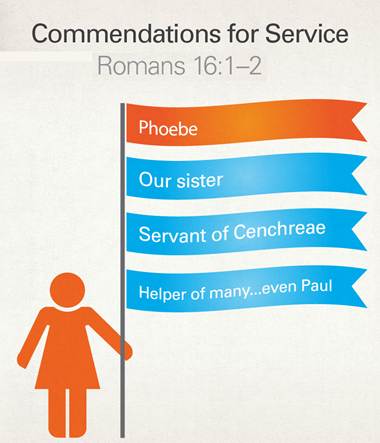
Commendations for Service: Phoebe is praised by Paul for her good service to those close to her, including the church at Cenchrea and even Paul himself.
Paul’s phrasing denotes her relationship to him and the others as the more relevant piece of information, to which is added the bit about her also/even serving the church in Cenchreae. Why does Paul commend Phoebe, this sister and servant? To request that the church receive her in a manner worthy of God’s people and to give her whatever help she might need. Phoebe deserved such help because she was a helper or patron of others, including Paul. He celebrates her noteworthy service and implies that it deserves reciprocation, essentially challenging the church to extend to Phoebe the very kind of patronage that she provided for others. By including himself as a recipient of Phoebe’s service, he implies that those who help her are essentially repaying the kindness he received from her (see Philemon 17–19).
Now imagine hearing those words read aloud about you in front of your church. Imagine having Paul hold you up as a commendable example of what it means to serve the Lord. Although Paul may not have a personal relationship with the church in Rome, they certainly know him by reputation. Cenchreae is located in Greece near Corinth, quite a way from Rome. So why mention Phoebe? If she did indeed carry the letter to Rome, Paul’s commendation of her would have served as a personal request for the church to give her the red carpet treatment when she arrived. And it likely would have had a corollary effect within the congregation of celebrating her as an example of faith and service. Paul’s commendation of role models can foster a dissatisfaction with our own service—in a good way. It prompts us to wonder whether our work for the church would warrant such an honor. So while Paul is clearly celebrating Phoebe, the same words simultaneously compel the listeners to reflect on their own level of service.
Paul then moves on to greetings that carry on the spirit of commending the recipients for their Christian service. Priscilla and Aquila were Paul’s coworkers in Ephesus. He practiced the trade of tent-making with them for more than a year (Acts 18:2–3). We find a curious variation from the ordering of their names where they are mentioned in the New Testament. When they are introduced in Acts 18:2 and then mentioned in 1 Corinthians 16:19, Aquila is mentioned first. In the remainder of the passages—including where they correct Apollos—Priscilla is mentioned first (Acts 18:18, 26; Rom 16:3; 2 Tim 4:19). The order of names is generally meaningful, especially where the ancient (and even modern) convention is to mention the male first. Paul (and Luke as writer of Acts) bucks this convention, essentially ascribing a more prominent role to Priscilla.
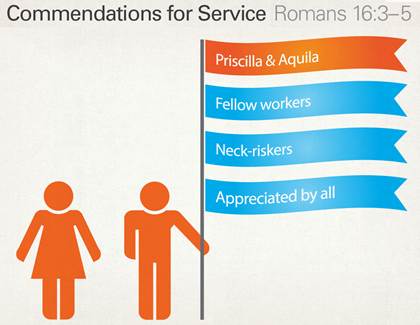
Commendations for Service: Priscilla and Aquila put their lives in danger in order to help Paul.
The relationship between Priscilla, Aquila, and Paul stretched back years before their return to Rome. Some in the Roman church may not have fully appreciated their connection. When Paul refers to them as “fellow workers,” he puts them on par with himself, as his peers in ministry. I have served in ministry over the years with retired missionaries, or had them in classes I taught. These missionary couples would rarely speak about their ministry other than to say where they had served. But when visitors would arrive—often younger missionaries whom they had trained—we heard countless stories about the impact the couple had had. While I had respected them all along, I found myself saying things like “I had no idea.” In the same way, we cannot know the exact context in which Paul delivered his commendation of Priscilla and Aquila, but we can imagine that it increased the respect others showed them.
Although Paul provides no specific anecdote for these two, he does state that they risked their necks for him. This risk-taking engendered not only Paul’s thanks, but also that of every Gentile church. Readers are left to imagine the situations Paul had in mind, but his words convey a powerful image of his deep respect and appreciation. Paul closes with a greeting to the church that meets in their home, adding yet another pennant to their metaphorical banner. All of this extra information about Priscilla and Aquila serves an important thematic function. It defines and shapes our image of them, and of those who actually knew them in Rome.
The greeting of Epenetus is much briefer and to the point. Paul describes him as the first convert of Asia, the capital of which is Ephesus. Scholars have speculated that Priscilla and Aquila may have played a role in his conversion or discipleship if the speculative connection to Ephesus is correct. Paul’s greeting of Epenetus right after that for Priscilla and Aquila strengthens the likelihood of a connection between them.

Commendations for Service: Paul briefly greets Epenetus, the very first convert in Asia.
Paul’s characterization of him as “my dear friend” quite likely would have shaped how others in the church viewed Epenetus. It is one thing to drop a name, to claim that you are a personal friend of a well-known celebrity; it is quite another to have that person call out your name or greet you from the stage. Paul’s statement here probably affected Epenetus himself, reminding him of the informal responsibility that comes with the designation as “first convert in Asia.” Another greeting, another banner lifted up to celebrate one of Paul’s connections to the church in Rome.
Paul very briefly mentions Mary in verse 6, commending her for working hard for the believers in Rome. Since he says nothing more, we can’t determine if this is one of the other Marys mentioned elsewhere in the New Testament. Whoever she was, her diligent service was more important to Paul than any position she may have held. By recognizing her service like this, Paul creates the corollary effect of challenging those listening to follow her example.
Paul’s next greeting pays tribute to two apostles with whom he served in ministry: Andronicus and Junia. Scholars have argued over how best to translate one word in this verse. If you compare translations, you’ll find some like esv and net translate the phrase to mean that Andronicus and Junia are well-known to the apostles, rather than among the apostles as in nrsv, niv, nasb and nkjv. The first group reads the verse as Paul acknowledging the respect the apostles have for them, whereas the second group sees Paul counting Andronicus and Junia among the apostles. The plainest reading of the troublesome preposition is option two, where Paul commends them as outstanding apostles.
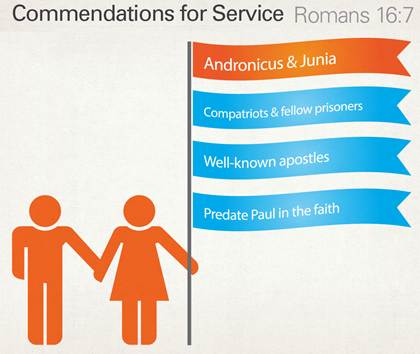
Commendations for Service: Paul greets Andronicus and Junia, who were imprisoned with Paul.
Andronicus and Junia did more than serve with Paul. They even went to prison with him, though we have no idea exactly when or where this happened. Sharing Paul’s imprisonment indicates their extraordinary commitment to proclaiming the gospel. And Paul provides another reason for recognizing the pair—namely that they both came to faith before Paul did. More time walking with the Lord means more time to grow and mature.
Paul’s comment conveys his respect for them and encourages others to hold them in the same regard. As with Epenetus, the status Paul attributes to Andronicus and Junia challenges them to continue to faithfully live up to their reputation. Paul’s high praise edifies them and spurs them on.
After verse 7, Paul’s greetings become briefer and often include more than one person at a time. Although these changes may imply that these people play a less significant role in Paul’s life, he still mentions each by name. The shorter greetings addressed to multiple people also create the sense that Paul is nearing the end of his letter.
Paul highlights one notable attribute about each person in his next three greetings. He calls Ampliatus and Stachys both dear friends, without providing any context for his comment. He refers to Urbanus as “our fellow worker in Christ,” connecting his service to the church with the likes of Pricilla and Aquila, to whom he also refers as fellow workers. Scholars believe these three were likely Gentiles based on their names and Paul not explicitly labeling them as fellow Jews.
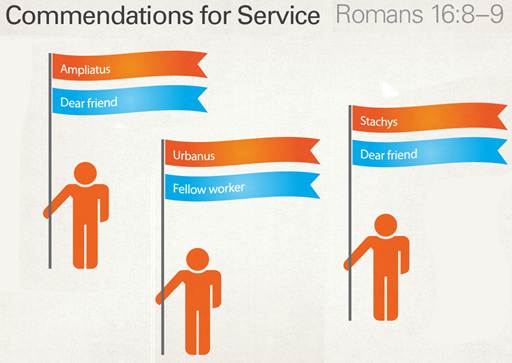
Commendations for Service: Paul greets Ampilatus, Urbanus, and Stachys.
Despite Paul mentioning only one trait about each of these three believers, by giving them explicit mention, he calls them out from the rest of the congregation.
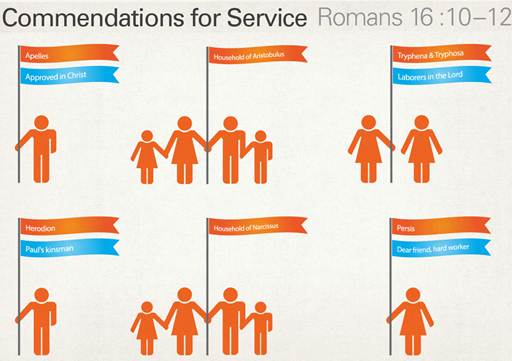
Commendations for Service: Paul greets Apelles, the household of Aristobulus, Tryphena and Tryphosa, Herodion, the household of Narcissus, and Persis.
Paul’s next greetings include references to households rather than churches meeting in a house (see 16:5). By mentioning the whole household instead of the head of the house, Paul makes sure no one is left out. We know nothing about Aristobulus, though according to tradition he was the brother of Barnabas, Paul’s fellow missionary (see Acts 9:26–15:41). Paul’s greeting to the household of Narcissus (16:11b) adds the caveat “those who are in the Lord,” implying that not every member or servant was a believer in this household as they were in the house of Aristobulus. Commending households or house-churches is a much more prototypical greeting based on the absence of any other thematic information to characterize those being endorsed. In contrast, Paul’s greetings of individuals in these verses all include personal information.
In his greeting of Apelles, Paul characterizes him as approved in Christ. This doesn’t mean the others aren’t approved, but it singles out Apelles as exceptionally noteworthy. Women figure prominently in Paul’s greetings, and he commends Tryphena and Tryphosa for their hard work in the Lord, ostensibly based on their service to the church. Paul’s characterization of Herodion can be taken at least two ways. The New English Translation interprets the expression as “my compatriot,” focusing on the role as a minister alongside Paul. Most versions translate the expression with an ethnic connotation, “my fellow Jew” (niv, leb) or “my kinsman/relative” (nasb, esv, nrsv). Depending on how one understands the term, Paul is either highlighting their shared Jewish roots or shared ministry responsibilities.
Paul then commends Persis, a woman he characterizes as beloved or dear to him. Scholars believe her name is taken from her regional origins in Persia. Such geographically oriented names were customarily given to slaves. Based on such speculations, Persis likely immigrated to Rome from the east, and thus knew Paul from before her days in Rome. As with the others, Paul celebrates her service and friendship. With only six known references to a Persis in Rome, we do not have enough thematic information to determine which woman Paul refers to.
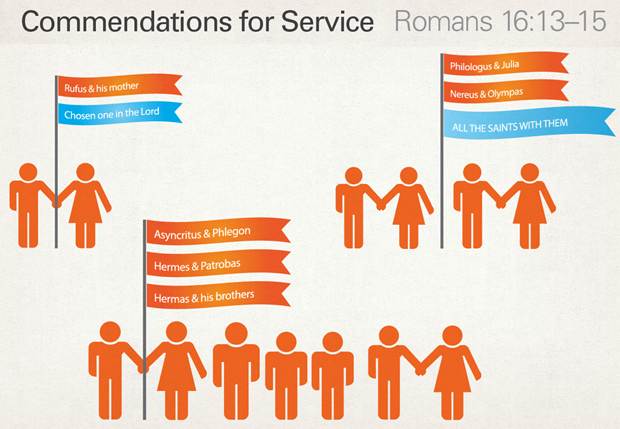
Paul’s final greetings are extended to families or house-churches, beginning with Rufus and his unnamed mother. Paul characterizes Rufus as chosen in the Lord, perhaps to remind him and others of God’s sovereign call on our lives to accomplish His purposes. Paul describes Rufus’ mother as having been a mother to him too. Most scholars understand this description as referring to a time when Rufus and his mother housed and cared for Paul while he was ministering in their area. People in ancient times placed a much higher value on hospitality than we do in the West today. Such hospitality meant more than offering a meal and a place to sleep. It meant embracing this person as a member of your home. The closest I have come to this kind of hospitality was when my family housed missionaries during a visit. Our meals were longer and our evenings later than normal as we shared stories of what God has been doing. Imagine having Paul as a house guest—the stories he could tell, the questions he could answer. No wonder he felt a special bond with Rufus and his mother.
In 16:14 Paul’s greeting addresses a group of men. He does not indicate the nature of their relationship to one another, but by commending them all in one statement, we know he must have perceived some kind of connection. Paul then adds “and the brothers with them.” He is likely greeting a house church by naming its leaders rather than addressing a large family of brothers. There are very few references made to individuals in Rome with these names, leading scholars to conclude that Asyncritus, Phlegon, Hermes, Patrobus and Hermas had immigrated to Rome from elsewhere in the Roman Empire. Scholars believe Paul knew Rufus and the others from his ministry in eastern parts of the empire.
Romans 16:17–24
Paul begins his final exhortations by calling his readers to beware of those who cause dissention and create obstacles to the faith, contrary to what they have learned. Paul has labored to correct the Romans’ practical understanding of the gospel at various points throughout the letter. He has carefully characterized his teaching as the way things always should have been understood, not as some new teaching. His frequent use of Old Testament quotations to support his claims adds to this understanding. For these reasons, we should pay close attention to how he characterizes opponents to the faith.
Since Paul does not explicitly identify them, he leaves the command open to broader application. He may be thinking of the Judaizers, those who demand that Gentile converts to Christianity must be circumcised. But he could just as easily be referring to Gentiles who denigrate Jewish believers for continuing to observe dietary customs and holy days that were no longer required under the new covenant. By using an ambiguous label, Paul addresses more potential troublemakers than if he had explicitly named a few.
Paul provides criteria for identifying dissentions and temptations: They are contrary to what the Romans have learned. Learned from whom, Paul or someone else? Paul doesn’t specify, which once again broadens the potential application of his exhortation. How can we discern between a prophetic voice and a dissenting/tempting one? We must consider the direction the voice is trying to lead us. If it leads us back to the truth, we would consider it prophetic, but if it calls us away from the truth we have been taught, we must consider it heretical or divisive. Paul has undoubtedly redirected the Romans on many matters, whether about the process of salvation or how our new life in Christ should affect our relationship with others. Thus Paul’s teaching should be included in their canon for determining either prophecy or heresy. At the end of verse 17, he shifts to a direct command: Stay away from them!
Paul devotes verses 18–20 to reasons the Romans should follow his commands. He continues to avoid specifying the opponents he has in mind by referring to them as “such people.” He characterizes them by what they do rather than what they stand for—that is, how to see beyond their deception. In 16:18 he portrays them as driven by their appetites rather than loyalty to Christ. When they speak, they are devoted to self-serving ends rather than to preaching the gospel.
Who do these people deceive? Again Paul uses a caricature rather than naming an explicit audience. Those with unsuspecting hearts are the ones who get taken in. This characterization essentially implies that anyone who pauses to listen to them is susceptible to deceit. Paul contrasts these easily deceived people with the Roman believers, who are renowned for their obedience. Commending their obedience in contrast to the others’ weak mindedness reinforces the positive example Paul wants the believers to follow.
Midway through 16:19, Paul returns to the theme he set aside in verse 17. Despite the deceptive opposition Roman believers may face, he rejoices because he is confident of their continued obedience. From a practical standpoint, Paul means that members of the Roman church are wise and knowledgeable when it comes to what is good, and quite the opposite when it comes to evil. And they should continue to study and invest in anything that is good. Although we could argue that there is value in knowing your enemy, Paul guides us in the other direction. There is an old anecdote about the U.S. Treasury Department training Secret Service agents to spot counterfeit bills—not by examining the fake bills, but by concentrating on the characteristics of true bills. The same principle is applied when Paul says the more the Roman believers know what is good, the easier it will be for them to stay away from what is wrong.
Paul has a compelling basis for commanding the believers to be wise in what is good: the nearness of the Lord’s return (16:20). He reminds us that this struggle against evil will not last forever, even if we may feel that way at times. Paul describes the Lord as “the God of peace” to remind the Romans that His peace will see them through whatever trials may lie ahead.
Final Reflections
Paul’s letter to the Romans is probably the most enigmatic of his writings. The theological concepts he outlines within it provided a basis for the Protestant Reformation. The structure and organization of the book have proven a mystery to many. With the help of linguistics and discourse grammar, the preceding commentary helps overcome some of the hurdles to understanding this letter. These tools help us recognize and properly interpret Paul’s grammatical signals and better follow his argument.
The biggest of these grammatical signals is the Greek conjunction gar, generally translated “for.” In the introduction, we saw how our understanding of this little word dramatically impacts our grasp of the letter’s structure. Instead of looking for a single, simple purpose that can explain the entire letter, we find that there are different levels of argument nested within others. From a formal standpoint, Paul’s desire to announce an upcoming visit is indeed an overarching purpose for writing; however, it cannot be neatly separated from the other purposes, such as building rapport for winning the Romans’ support for Paul’s mission to Spain, or that little section between Romans 1:16 and 15:22 about Paul’s gospel. Understanding the transformational power of the gospel does more than improve our theology. It provides the very basis for our own transformation and that of those around us. It has the power to fundamentally change our relationships with God and others, both inside and outside the church.
Despite questions that might remain about certain passages or theological concepts, we must apply the things that we already understand. Paul’s objective for presenting his gospel to the Romans is made clear in 12:1–2: “Therefore I exhort you, brothers, through the mercies of God, to present your bodies as a living sacrifice, holy and pleasing to God, which is your reasonable service. And do not be conformed to this age, but be transformed by the renewal of your mind, so that you may approve what is the good and well-pleasing and perfect will of God.” With these verses, Paul challenges us to move from understanding to acting. This transformation is the very reason God sent His Son.
As Paul says in Philippians 1:27, let us live in “a manner worthy of the gospel of Christ … standing firm in one spirit, with one soul contending side by side for the faith of the gospel.” It is my prayer that this study has instilled in you a greater desire and ability to pursue this goal.
About the Author
Steven E. Runge serves as a Scholar-in-Residence at Logos Bible Software. He has a Doctor of Literature degree in Biblical Languages from the University of Stellenbosch in South Africa, supervised by Christo Van der Merwe. He currently serves as a research associate affiliated with the Department of Ancient Studies, University of Stellenbosch. In preparation for his doctoral research, Steve completed several years of study in the linguistic fields of pragmatics and discourse grammar. This culminated in attending a workshop on discourse analysis offered by SIL/Wycliffe Bible Translators, facilitated by Stephen H. Levinsohn. He has also earned a Master of Theological Studies degree in Biblical Languages from Trinity Western Seminary in Langley, B.C., and a B.A. in Speech Communication from Western Washington University.
Steve has served as a
visiting professor teaching Greek discourse grammar at Knox Theological
Seminary; Dallas Theological Seminary; and Wycliffe Hall, Oxford; Wales
Evangelical School of Theology; and Southern Baptist Theological Seminary,
besides offering exegesis workshops for pastors. While completing his education
Steve served as an adjunct faculty member at Northwest Baptist Theological
College, Trinity Western University, and Associated Canadian Theological
Schools (ACTS). He and his wife were married in 1990. They have two daughters
and live in Bellingham.