Steven
E. Runge, High Definition Commentary: Romans
(Bellingham, WA: Lexham Press, 2014), 99-104
Romans 5:12–21
As we read Romans 5:12, we need to be sure we’re reading it for what it says, not for what we think it says. Let’s take it in pieces before trying to put it all together.
1. Sin came into the world through one man (assumed knowledge, since it is found in the “just as” part of the comparison).
2. Death [came into the world] through sin (second part of the comparison, no verb in the Greek).
3. Death spread to all people, because all have sinned.
Paul uses these statements to chart the entrance of sin into the world. Sin came into existence through one man, Adam. There was a not-so-great bonus that came with sin: death. When sin entered the world, so did death.
Now hang on, don’t jump ahead. What spread to all people, sin or death? Paul uses the word death, not sin. Death entered as a natural consequence of sin. Death spread because all have sinned, and the wages of sin is death. So what is Paul claiming here? Note that Paul does not say that sin spread. Death is a consequence of sin, just as the wrath of God described in Romans 1–2 is a consequence of sin.
So what can we conclude from this verse? Paul says death is the penalty for our sins, not an inheritance from Adam. The introduction of sin into the world brought about a number of fundamental changes. Chapters 7 and 8 are going to look in much greater detail at how this works on a practical basis, since we have bodies of flesh that suffer from sin’s effects. But let’s not jump ahead.
Paul’s point in this section is to trace the path of carnage wrought by the entrance of sin into the world (and into our flesh) as a way to elaborate on all that Christ has accomplished through His death and resurrection. More important, Paul explains why it had to happen this way, tracing the parallels between Adam and Jesus.
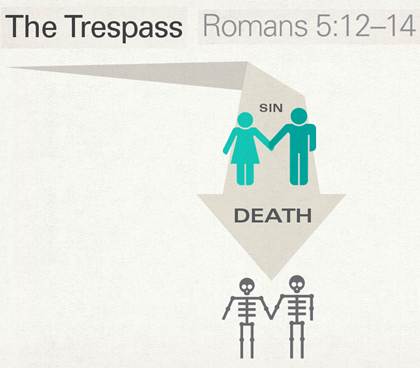
The Trespass: This is the beginning of a complex explanation describing in practical ways how Adam’s sin changed everything. Note the text says that death spread to all as a result of sin, rather than sin spreading to all.
So death entered the world as a consequence of sin, and we live under the looming shadow of death because we all have sinned (Rom 1–2). Paul offers a supporting statement in verse 13 to remind us that judgment for sin is tied to the law. So while sin was in the world—along with its consequence, death—there was not an accounting for the sin. The coming of the law changed all that, opening the door for a full accounting to be made (3:19–20). It’s not as if people were getting off the hook; after all, everyone but Enoch and Elijah had died. What Paul has in mind here is God reconciling accounts for the sin committed. Before the law, there could be no accounting (5:13); but when it did finally come, God chose to exercise His kindness, forbearance, and patience with a view toward repentance (2:4).
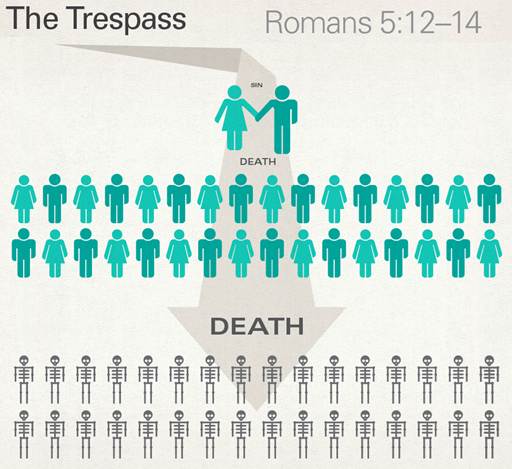
The Trespass: When Adam sinned, death was introduced into the world along with sin. As others sinned, death also spread as a natural consequence; thus all died.
Verse 14 supports this idea of sin being present but not being judged. This is how it was able to reign in the world from the time of Adam to that of Moses. It reigns over everyone—even those of us who did not sin in the likeness of Adam’s sin. What exactly does that mean? (Cue the dramatic voice over.) “In a world where there was no sin, a world where there was only good, one man and one woman made one choice that changed everything.” In 5:14, Paul characterizes Adam’s sin as somehow different from ours. Paul later characterizes sin as living in (and ruling) our flesh, but this was not Adam’s situation before the fall. Adam had been sinless and without an occupying force in his flesh. He had a clear choice in the matter. From Paul’s perspective, we are all born now with this urge living under our skin—and it all traces back to the decision of one man, a decision that affected all who follow.
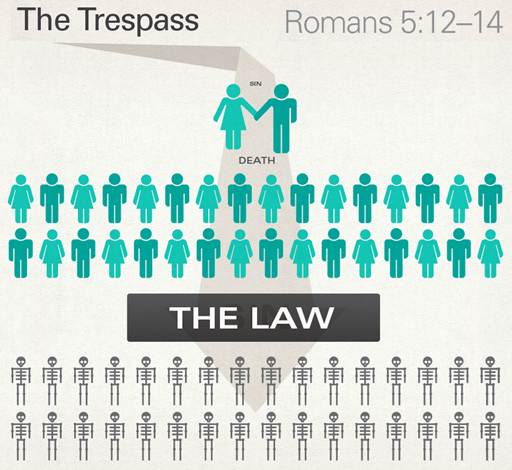
The Trespass: The introduction of the law into the equation did not change the outcome. Sin results in death—the law simply highlighted the problem of sin rather than offering a solution to it.
The uniqueness of Adam’s sin provides a basis of comparison to the uniqueness of Jesus’ life and death—and why things had to happen the way they did, as we see in verse 15. From Paul’s perspective, both Adam and Jesus brought something into the world that affected everyone. Although they were both “the first” in some sense, that’s where the comparison ends. Adam brought trespass into the world, but Jesus brought a gift. With Adam, death multiplied because all have sinned; with Jesus, grace multiplied as God’s gift of forgiveness was offered to everyone (5:15). There is also a fundamental difference between the gift and the sinner who created the need for the gift (5:16). Whereas the judgment led to condemnation of the one sin, the gift led to the justification of many sins. Each one changes lives—but with different causes and with very different effects.
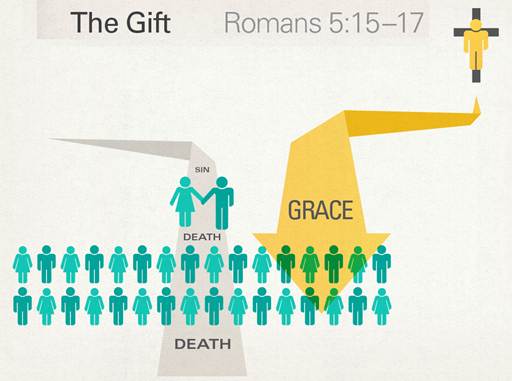
The Gift: The gift was introduced through one man, just like the trespass in some ways, but drastically different in others. Instead of death spreading to all, the gifts of grace and righteousness spread to all who respond in faith.
Paul elaborates on this distinction in verse 17, where he compares the magnitude of the sin with the magnitude of the gift of grace. Sin not only introduced death into the world; Adam’s sin also enabled death to literally rule the world—nothing can break free from its grip. But think how much bigger an impact grace can have. Instead of living in fear of death, those who believe reign in life through Jesus, the one who made it all happen.
Verse 18 begins a new thought, drawn out as a consequence of the preceding section. Here Paul compares the results of the trespass and the gift: Adam’s one act led to condemnation for the world, and Jesus’ one act made life-giving justification available to the world.
In verse 19, Paul explains how one man’s sin could lead to such devastation. That original act of disobedience led to many becoming sinners through their own disobedience. This disobedience stands in sharp contrast to the obedience of the one, Jesus. His obedience made righteousness available to many—to all who were sinners and stood condemned. Verse 20 adds a new point to the support material begun in verse 19. Paul returns to the relationship between the law and sin, last mentioned in 5:13. He reaffirms that the purpose of the law was to promote the knowledge of sin (3:19–20)—but there is a corresponding principle at work. As the knowledge of sin increased, grace increased all the more: Grace will always triumph over sin.
Paul closes the chapter with a purpose statement about how sin and grace work in the divine economy. He invokes our knowledge of sin’s comprehensive reign of terror, resulting in death. In this same way, grace, too, would reign over everything through righteousness, resulting in eternal life through Jesus Christ for all who believe.
Paul opens a can of worms in verse 20, introducing a theme he will unpack in the next two chapters of Romans. Each of the major rhetorical questions that follow in Romans 6–7 relates back to a different “worm”—a different issue that remains unanswered in 5:20. Although Paul’s discourse advances in the next few chapters, keep in mind that it does so by continually referring back to issues raised in 5:20.