Steven
E. Runge, High Definition Commentary: Romans
(Bellingham, WA: Lexham Press, 2014), 113-116
Romans 6:15–23
Paul concludes the first half of this chapter with exhortations to refuse to allow sin to reign in us, and to offer ourselves to God instead, as instruments of His righteousness. Paul now continues by offering a rationale for following these commands. In 6:15 he asks a rhetorical question that forms the basis for the argument that follows in this section. Should we continue in sin because there is no longer any condemnation awaiting us? If the penalty of sin is removed, why not just go ahead and sin? Paul answers by addressing the issue in terms of slavery.
He frames verse 16 as if the answer is obvious. When we choose to sin, our action has greater ramifications than we might realize. We are choosing to offer ourselves to sin instead of to God (6:12–13). In doing so, we choose whom we will obey—to whom we will enslave ourselves. Before Christ entered our lives, we had no choice—we were slaves to sin (17a), and that enslavement leads to death.
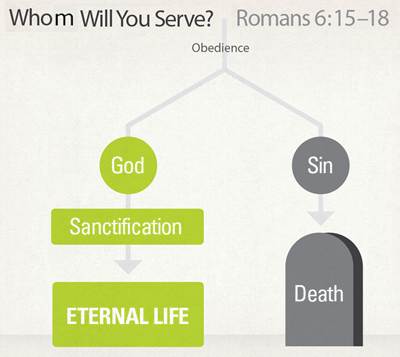
Whom Will You Serve? Our choice about who we serve has significant ramifications. If we serve sin, the only outcome we can anticipate is death. Contrast this with serving God, a choice that leads to sanctification and eternal life. By presenting it this way, Paul makes the decision simple; we just need to focus on the long-range consequences of our decisions.
But now, we have a choice about what or whom we serve. Responding in faith to Christ enables us to serve God, which leads to sanctification and ultimately to eternal life. Although we were once slaves to sin, Paul states that obeying the teaching God has entrusted to us will change our outlook (6:17). We are able to enslave, or devote, ourselves to righteousness and service to God. In 6:19, Paul lets us know that this analogy breaks down at some point—that he is relying on familiar concepts to communicate most effectively with his audience. Even so, at the end of the verse, Paul challenges us to devote ourselves just as fully to pursuing righteousness as we used to devote ourselves to sin and lawlessness.
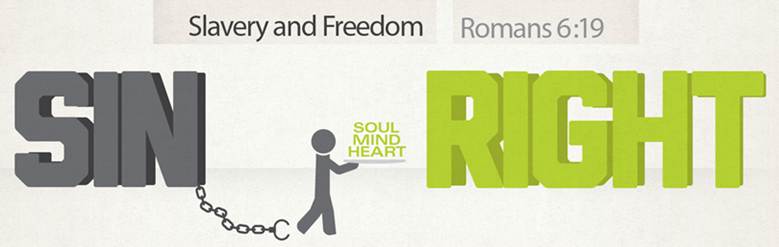
Slavery and Freedom: We used to present ourselves as slaves to sin. But having been set free from sin, we now have the opportunity to present ourselves as slaves to righteousness, leading to sanctification.
Verse 20 sounds odd, but it’s an important idea. The freedom from righteousness we enjoyed as slaves to sin wasn’t really freedom since we had no other choice.
For many years I misunderstood this idea, so let’s look at this verse more closely. I acted as though once I became a Christian, sin would die, and I’d just serve God. Sure, there was a struggle, but it wasn’t a big deal. But by reading Romans more closely, I realized that Paul never says sin is dead. Instead, he tells us to consider ourselves dead to sin (6:11). That’s a huge difference. God does not promise that sin will never reign in me; He exhorts me not to allow it to happen (6:12). This brings us back to the issue of choice.
Now that we have a choice about whom we serve, we need to make that choice consciously. Our natural inclination is to fall back on our old patterns and re-enslave ourselves to sin. Paul challenges us in verse 21 to pause and think back to our old life, the one we are to consider dead. Actions that brought us remorse or shame—do we really miss them? Do we want to go back to that way of life?
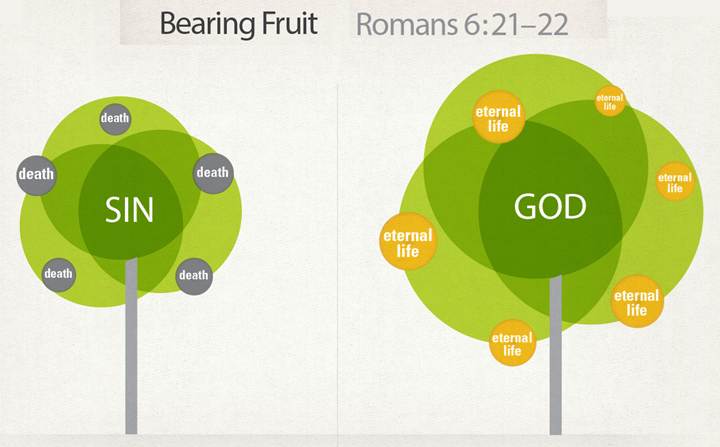
Bearing Fruit: Paul uses the analogy of bearing fruit to create another contrast between serving sin and serving God. Either way, we will bear fruit—but what kind of fruit do we want to bear?
What kind of fruit do you want to produce with your life—fruit that leads to death or fruit that leads to eternal life?
In 6:23 Paul concludes the chapter with what has become a famous memory verse—but one I doubt is properly understood in its broader context. Paul appeals to believers not to return to their old lives, and he offers this statement as motivation to fight the urge to re-enslave ourselves to sin. In his parting shot, Paul forces us to consider what “wages” we will receive for our devotion. A life devoted to serving God leads to eternal life. This life won’t be easy, but we have the promise that being indentured to God will sanctify us and make us more like Him. The alternative is death—death is the “reward” for a life of sin. As believers, even though we have accepted God’s gift of righteousness by faith and we are delivered from the penalty of sin (6:1, 15), we still must choose where we will devote our lives. Paul challenges us to invest in a life that will pay the dividends that God intended.