Steven
E. Runge, High
Definition Commentary: Romans
(Bellingham, WA: Lexham Press, 2014), 117-
Romans 7
Romans 7:1–6
Verses 1–6 are not the beginning of a new section, but rather the continuation of the previous one. In these verses Paul resumes an idea he left off in 6:14, providing an alternative line of thought based on the use of “or” in 7:1. In Romans 6:14 Paul claimed that sin will not be master over us because we are not under law but under grace. Here in 7:1, he introduces the role death plays in determining the jurisdiction of the law. He uses marriage as a practical example to illustrate his point. Marriage is a legal contract, and contractual obligations end with death. The same actions can have very different consequences depending on whether legal obligations are in force.
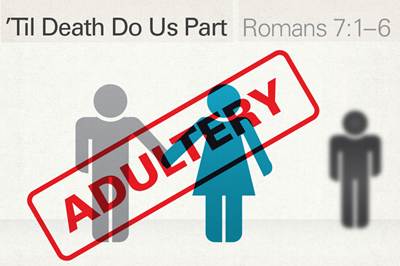
’Til Death Do Us Part: In yet another argument against continuing to sin, Paul appeals to the legal restrictions governing marriage. We were once bound to the law until death parted us. This bond to the law is so strong that joining with another is forbidden as long as both members of the marriage covenant are alive.
If someone is married and they join themselves with someone other than their spouse, the action is classified as adultery. Not so if the spouse has died.
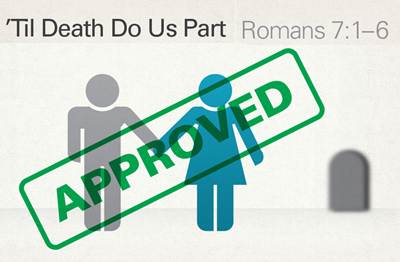
’Til Death Do Us Part: If we reset the scenario to the original legal obligation, it becomes clear that everything changes when one of the legally bound people dies. If one of the legally bound spouses dies, the surviving spouse is free to join with another person. This behavior, which would have previously been labeled adultery, is now approved. Death changes everything as far as legal obligations are concerned. In the same way, having died to sin and the law means we are no longer obligated to either of them.
Rather than being considered adultery, marrying someone else after your spouse has died is simply remarriage (7:3). Other than quibbles over how long one ought to wait before remarrying, there are no legal or moral prohibitions against remarrying. After this explanation, Paul applies the same principle to sin in 7:4.
Paul makes the point that our having died with Christ has important consequences regarding our status under the law. Death has freed us from the law so that we can be joined to another person. This is not a physical death; that comes later. This is death to the law, which frees us from a legal obligation to live under its jurisdiction. When we lived under the law, our sinful desires manifested fruit for death. But dying with Christ changes everything, or at least it is supposed to. We no longer have to live in bondage to sin. Instead we are free to serve God, bearing fruit for righteousness.