Steven
E. Runge, High
Definition Commentary: Romans
(Bellingham, WA: Lexham Press, 2014), 135-142
Romans 8
Romans 7:25b–8:11
Before you read any further, go back and review the commentary on Romans 7:13–25a in the preceding section. Much of what follows presupposes your understanding of this material.
In this section of Romans, Paul presents practical strategies for overcoming the ongoing problem of our sinful flesh. In 1:18–20, he discloses God’s response to our sin: His wrath against all godlessness and wickedness. Most of Romans 1–4:25 explains that Jews and Gentiles alike are under this wrath, and we all share the same need for reconciliation with God. In Romans 5:1–7:25a, Paul addresses the role that God’s righteousness, revealed in the gospel, plays in the lives of believers once they have been reconciled with Him. At the end of Romans 7, he introduces the ongoing problem of sin in our unredeemed bodies. Another important aspect of the gospel’s power is the new life that it opens up to us—not only eternal life here, but life in the Spirit. What follows is the beginning of the next big thematic unit, looking at life in the Spirit as the solution to the lingering problem of sin.
Now That We Have Peace: The preceding sections have dealt with all the implications of God’s wrath being revealed against all impiety and unrighteousness. Paul has presented the gospel, the revelation of God’s own righteousness, to address the penalty of sin. He now transitions from describing life under judgment to talking about the new life believers can experience now that we have peace with God.
When God redeemed us through Jesus’ death and resurrection, He knew sin would remain in the flesh. He could have dealt with this problem by bringing about the immediate judgment of the ungodly and the bodily redemption of believers, just as we expect will happen in the future “day of the Lord.” Instead, God relied on the very same model that Jesus used to resist the sinful longings of His flesh. He gave us His Spirit to dwell in us and help us live in humble submission.
For us to follow God, we had to be free from slavery to sin and its penalty—that was just the beginning. To build on this foundation, we must actively submit to the Spirit’s ministry in our lives. God’s indwelling Spirit enables us to be “saved by His life” (5:10); His life is lived out through us as His instruments for righteousness.
Since Paul presents a big idea to build on what he has already argued in Romans 1–7, he is able to present a more complete picture now than was possible earlier. He provides a great summary and review, but we must read it in light of all of the caveats and support he has already offered. We must assume all of the rhetorical questions excluding wrong ideas are still true, and we must read the chapter in the broader context of what precedes. Romans 1–7 serve their own purpose, but they also serve as the preamble for Paul’s most important teaching about how we can serve God despite the fallen state of our world.
Paul’s opening statement for this section is the hinge verse, 7:25b. Our inner person/mind is set free to be a slave to God’s law; nevertheless, the problem of inherent sin wages a constant battle. Romans 8:1 reiterates the claim of 5:1: being justified by faith means peace with God, so there is no condemnation. Verse 2 recasts our reconciliation with God in legal terms, contrasting the law of sin and death with that of the law of the Spirit of life in Christ Jesus.
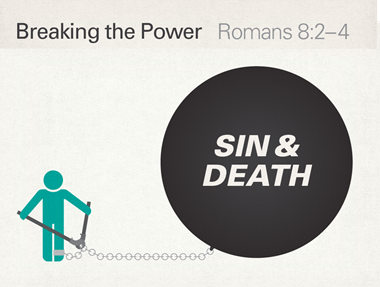
Breaking the Power: Paul makes clear that God never intended for the law to address the problem of sin. The law promotes knowledge of sin rather than offering a solution.
Paul packs a lot of significant information in one complex sentence. God never intended the law to save us from sin and death. This was not possible because of the weakness of our flesh.
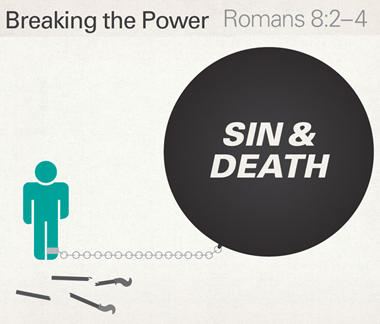
Breaking the Power: Paul points out that the law was never meant to offer a solution to the problem of sin. Therefore, any attempt to use the law to obtain freedom from sin or death is doomed to fail.
God accomplished what we could not, through Jesus’ work on the cross. He had to come in the flesh, susceptible, as we are, to the effects of sin. In this way, Jesus fulfilled the righteous requirements of the law in us and put sin to death once and for all. His death and resurrection broke the power of sin and death.

Breaking the Power: In Romans 8:3 Paul says that what the law was powerless to do, God did by sending His Son. He condemned sin in the flesh by being incarnated in flesh just like ours.
Paul gives us a heads-up about where he is headed in 8:4 by recasting us as those “who do not live according to the flesh but according to the Spirit” (leb). Most Bible translations render “spirit” here as though it refers to the Holy Spirit. However, Paul’s references to spirit in the next few verses seem to continue his contrast between the inner/outer, body and spirit. In other words, he is still referring to the inner, redeemed spirit in contrast with the flesh.
When Paul contrasts living with a focus on the flesh versus living with a focus on the spirit, he is speaking to believers, so he is able to assume that their inner spirit has been redeemed. Nevertheless, he clarifies this in verse 9 with the caveat, “if indeed the Spirit of God lives in you” (leb). If Paul had been talking about the Holy Spirit dwelling within us instead of simply our inner person/spirit, there would have been no need for this clarification. Now let’s take a closer look at the contrast.
What we focus our minds on has direct consequences for how we live our lives. In 8:5 Paul outlines the contrast between a life focused on the flesh versus a life focused on the inner person/spirit that has been redeemed.
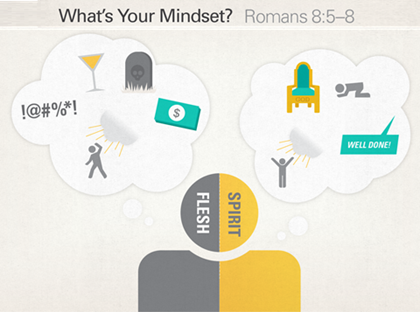
What’s Your Mindset? Paul presents contrasting portraits of the mind set on the flesh compared to the mind set on the spirit. Although there is no longer condemnation for those who are in Christ Jesus, we still face a choice of where we set our minds.
The mind set on the flesh cannot serve God because of the inherent enmity, and because the sinful flesh is under judgment leading to death. All flesh is doomed to die; if our life is focused on serving our flesh, we cannot simultaneously serve God. As Paul summarizes in verse 8, those in the flesh are not able to please God.
In 8:9 Paul shifts from the generic exposition to an application. Living our life focused on the spirit changes everything, so long as the Spirit of God lives in us. The Spirit-indwelt life is one of peace. In 8:10 Paul summarizes our present state as believers with Christ in us: Our physical body is dead because of sin, but our spirit/inner person is alive because of the righteousness obtained as a free gift from God. Paul recharacterizes God in verse 11 as “the one who raised Christ Jesus from the dead” (LEB). If the life-giving Holy Spirit lives in us, then He will also vivify our mortal bodies through the indwelling of His Spirit. This “making alive” of our bodies gets more attention in verses 18–30, but the point here is that the indwelling of God’s Spirit in our spirit changes everything. Reconciliation and peace with God are just the beginning. Allowing Christ to live in us and through us to serve God is what Paul’s gospel message has been building toward. Through His plan to remove sin and wrath, God prepared the way for His greater design for us.