Steven
E. Runge, High Definition Commentary: Romans
(Bellingham, WA: Lexham Press, 2014), 123–127
Romans 7:7–12
Recall that in Romans 5:20 Paul claimed that the law came so that sin would increase, opening a huge can of worms for those who had devoted their lives to keeping the law. Paul addressed the first worm: whether we should sin so that grace might increase. The second worm is whether the law is sin; this is a logical question based on Paul’s assertion in 5:20 that the law came to magnify or increase sin. Wouldn’t that make the law itself sinful? Although the answer to this rhetorical question is “no,” there is indeed a link between the law and sin. The law serves as a lens that changes our perspective on what’s happening around us.
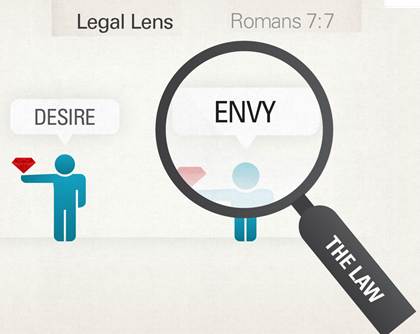
Legal Lens: Paul explains that what he used to see as desire, he now understands to be envy. The perspective gained from the law reveals that what had seemed to be morally neutral actually has sinister origins.
Before the law came into our lives, we could equate want with desire. An understanding of the law teaches us about covetousness and envy. We are now accountable for our desires, knowing that lust for something we want is really envy.
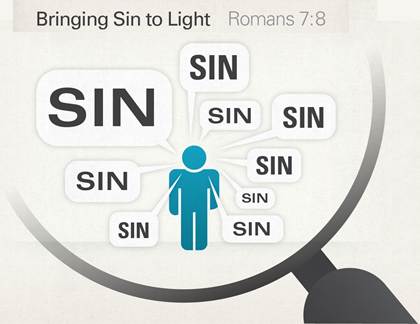
Bringing Sin to Light: The law has a much broader application than just recasting desire as envy. In fact, the more I apply it to my life the more areas of sin I find.
With the law as a lens through which to filter and evaluate our actions, we quickly realize that the law is not the problem. Sin is the problem. Sin has always been present, but we didn’t recognize the degree to which it had infiltrated our lives. Remember Romans 5:20 and the question of whether the law increases or magnifies sin? The legal lens is what does this—it helps us see what has always been there. No longer can we live in ignorant bliss. Now we are accountable.
And it’s not just that the law shows us how much sin is in our lives. Sin has another sinister aspect. In Proverbs 9:17 we find a horrible principle associated with prohibitions: Temptation is magnified whenever we are told not to do something. Let’s call it the “stolen water is sweeter” principle. Of course stolen things are not sweeter or better than things we acquire lawfully; the “sweetness” is a matter of perception. Somehow, knowing that we are banned from doing something—like stealing—seems to increase our desire to do it.
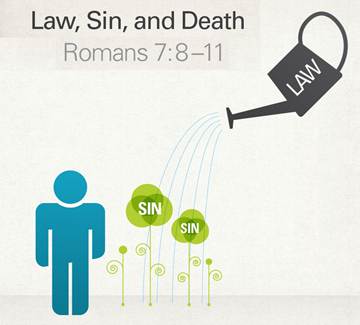
Law, Sin, and Death: There is a terrible progression to sin once the law brings it to light. Instead of discouraging sin, it seems to cultivate more of it.
So this magnification process has two facets: It magnifies our understanding of sin, helping us distinguish legitimate desires from sinful ones. But it also magnifies our desire to sin, making it more irresistible. In verse 8, Paul personifies sin as a tempter, taking advantage of the law to call our attention to every opportunity to sin. The law does not produce envy, but it heightens our awareness of sin and increases our desire to act sinfully—the “stolen water is sweet” principle. It prompts us to believe the lie.
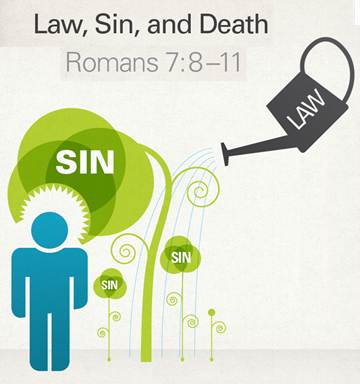
Law, Sin, and Death: The law brings sin to light and continues to cultivate more of it. Finally, sin leads to death.
These two types of magnification of sin lead to a natural conclusion: death. At the end of verse 8, Paul claims that sin was dead before the law, but knowledge of the law makes sin spring to life. Sin deceives us into thinking that forbidden things are some kind of undiscovered treat. This is precisely the lie that led to the fall in Genesis 3:6, that that the fruit was good to eat, pleasant to the eyes, and desirable for making one wise. The very same lie is still at work in us today.
Paul summarizes the state of affairs in verses 10–12. When we first sinned, something in us died. Sin deceives us and then eats us alive when we turn to chase after it.
Returning to the question with which Paul began this section: Is the law really sin(ful)? No. Rather, it is the sin present in us that has caused all the problems. Knowledge of the law increased both our knowledge of sin and our desire to chase after it, leading us straight to our deaths. And the law? It is holy and righteous and good, not sinful, because it reveals God’s holy nature to us in a way we can understand. The law has the God-ordained function of magnifying sin in terms of quantity and intensity.