Steven
E. Runge, High Definition Commentary: Romans
(Bellingham, WA: Lexham Press, 2014), 147-152
Romans 8:18–30
In this next section, verses 8:18–30, Paul strengthens his preceding argument without introducing a new point. He’ll pick things up again in verse 31. He has just introduced the idea of looking forward to being glorified like Christ, anticipating the day when the power and consequences of sin are voided by a return to the way God intended things to be. We often tend to think only of ourselves without considering God’s much larger plan. Paul now connects the notion of our flesh needing final redemption to the broader idea of all creation sharing this need.
Going back to verse 17, Paul mentioned the inevitability of suffering with Christ as part of our identification with Him. Knowing what Christ went through, we might be tempted to question whether the suffering is worth it. Maybe serving the flesh is the better route after all. Paul quashes this idea by stating that our present battle against our sinful flesh is nothing in comparison to the glory that awaits us. Suffering sounds so ominous from our perspective, and it is. But if we exchange our short-sighted view for a long-range perspective, we’ll see that what lies in store for us—and we will have no doubt that what we endure in this lifetime will be worth it in the long run.
On that fateful day in Eden (Gen 3:1–19), all of creation was corrupted along with Adam and Eve, and it continues to be subjected to the same futility we face as human beings. If we focus only on the present, everything can seem meaningless. But creation was subjected to sin in hope, in anticipation of something more to come (Rom 8:20). In verse 21, Paul reminds us that just as the sons and daughters of God await the redemption of their fallen bodies, so too does all of creation await its restoration to God’s plan. If we look around, we see that the death and decay we experience as a consequence of sin affects everything around us. God never intended for creation—or us—to suffer. The effects we see in our lives and throughout the world have been brought about by sin. So another aspect of condemning and removing sin involves removing it from the world. In fact, Paul says creation itself groans with longing for that day of redemption—perhaps even more than we do.
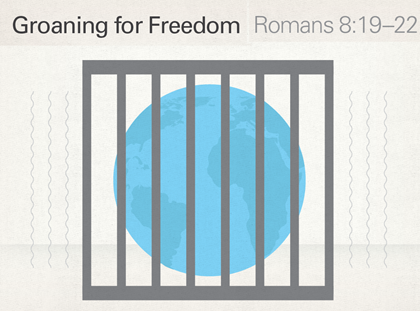
Groaning for Freedom: Humanity is not alone in waiting to be redeemed from the consequences of sin. All of creation waits, groaning in anticipation.
Paul transitions from creation’s longing to our own, a longing for the day when the battle with our sinful flesh will finally end. In that day, our redeemed inner person will have a redeemed and glorified body as well. The indwelling of God’s Spirit is a preview of what lies ahead for us. We, too, should be groaning in anticipation, not grumbling about the suffering that lies between now and eternity.
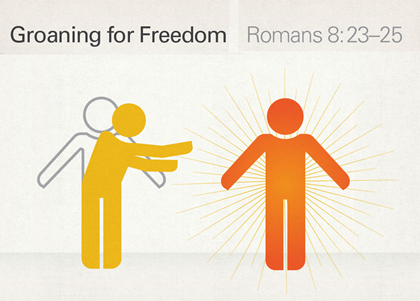
Groaning for Freedom: Just as creation eagerly awaits final redemption, believers also await the renewal of our bodies. No longer will there be the war between our flesh pursuing sin and our inner person pursuing God.
In that day God’s adoption of us will be complete—He will restore our relationship to what He originally intended it to be. Paul describes this complete adoption in verse 23 as the redemption of our bodies, an act that will complete the process initiated when God sent His Son to bring about our redemption and righteous standing before God by faith. For now, Paul says, our redemption lies in hope rather than completeness (8:24). Hope by definition includes a not-yet component. Paul circles back in verse 25 to the relationship between our present suffering and our future hope. We must exercise patient endurance in our present trials, grounded in faith as we eagerly await that completeness.
Paul began this section by stating that creation, too, is eagerly awaiting redemption. He adds us to this equation using a “not only this, but also …” transition in verse 23. But Paul looks to factor in one more element—especially in light of the sufferings and adversity we face while we are waiting. He returns to the firstfruit of adoption that we received: the indwelling of the Holy Spirit. The trials and suffering that stem from sin may be inconsequential in light of eternity, but they nevertheless can have devastating effects in our lives. God’s Spirit not only indwells us; He plays an intercessory role. So although Paul downplays our present hardships, he does not ignore our struggles to endure and overcome them. God’s indwelling Spirit comes in and leads our spirit. In those times when discouragement and pain defy description, it turns out that there really isn’t even a need for words when we pray. Rather, God, who searches our hearts, knows the mindset of His Spirit within us. The Spirit intercedes on our behalf based on His perfect knowledge of God’s will (8:27).
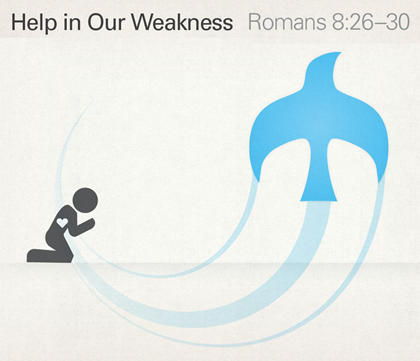
Help in Our Weakness: As we await complete adoption—the redemption of our bodies—we are not alone in our struggle with the flesh. God’s Spirit helps us in our weakness, interceding on our behalf.
Since Romans 8:28 is a familiar verse, we should slow down and examine the detail it contains. Paul does not claim that all things work together for good for everyone; he has a specific subset of people in mind. He first describes this group as those who love God, and then recharacterizes them as those who are called according to His purpose. This recharacterization specifies how we should understand “working together for good.” It is not our definition of what good looks like—rather, God’s purposes determine the good. He calls us with a specific purpose in mind, and we can have the utmost confidence that all these things we face—including our present suffering—are working together as part of a larger plan that God has ordained. Paul goes on to describe this scenario in more detail.
Verses 29–30 are full of theologically loaded terms; I am not going to try to unpack them all. The way Paul phrases them in Greek tells us he is more interested in our understanding of the intentionality of God’s redemptive plan than in helping us fully understand each of these steps. The phrasing in Greek is slow and drawn out, allowing us to think about each new topic before Paul comments on it. By using “also” in each of the statements, he creates a closer connection between each one, constraining us to add the new phrase to what precedes.
Paul begins this sequence with the assumption that God foreknew us, not unlike the intimate knowledge described in Psalm 139. These people whom God foreknew, He also predestined to be conformed to the image of His Son, Jesus. It may come as a surprise that being conformed to Jesus’ image is not for our benefit: God’s desire is for Jesus to be glorified as the firstborn of all creation and to hold this preeminent position over creation. Once again we are reminded that although God loves us and has a wonderful plan for our lives, this plan is more about Him and His bigger purpose than about our happiness. Whatever benefit we gain in being conformed to God’s image is ancillary to His greater purpose in seeing His Son properly honored.
In 8:30, Paul builds on the notion of God’s foreknowledge and introduces a new topic. The ones God foreknew, He also called. And the ones He called, He also justified. And the ones He justified, He also glorified. These statements give us the grander picture of God’s plan. Paul has already covered the concepts of our call and justification, and he has explained God’s desire for Jesus’ glory. His statement about glorification describes that final redemption, when our sinful flesh will be done away with. In this sense, 8:29–30 describe the whole process even though we are still awaiting the last step (see 8:18, 23). Paul’s claim in verse 28 that all things work together for the good of those who love God is bolstered by the bigger picture—God’s plan as outlined in 8:29–30. The final step of glorification is when all things will be set aright, when the longing and groaning will finally end.
Verses 18–30 serve to strengthen Paul’s claim in verse 17 that we are heirs of God and fellow heirs with Christ, even though that honor comes with the caveat: Suffering together with Christ is part of being glorified together with Him, and Paul builds the case that the glory that awaits us makes whatever suffering we might experience now more than worth it in the long run. All of creation longs for the final redemption when it, too, will be made new. God’s long-range plan, Paul says, is what enables all things to work together for our good (verse 28). It doesn’t mean current suffering will end; instead, we need to rest in the assurance and anticipation of God’s ultimate plan for us and for all His creation.