Steven
E. Runge, High Definition Commentary: Romans
(Bellingham, WA: Lexham Press, 2014), 153-55
Romans
8:31–39
In
this section, Paul returns to the big ideas he introduced in verses 16–17
before putting them aside to address the issue of suffering in verses 17–30. We
now understand that we will face suffering and hardship in the short term, but
that all things will be restored as part of God’s larger plan. Most of us in
North America live a pretty tame existence compared to Paul and the other
first-century Christians. In 2 Corinthians 11:24–28, Paul provides a lengthy
list of the perils he faced. Even so, he remained confident of God’s continuing
presence and guidance in his life. Rather than viewing these trials as signs of
abandonment, Paul attributes them to life in a fallen creation that awaits
final redemption. He makes this point in Romans 8:31–36.
His
rhetorical question in verse 31 introduces the big idea for this section.
“These things” refers back to sufferings addressed in the preceding section.
The rhetorical question “what” points forward to the claim in the second half
of the verse. Note that Paul is not claiming that we won’t face opposition,
instead he almost assumes it. The more important question is what will happen
to that opposition since God is for us.
It
is natural to be anxious in the face of trials, tribulations, and opposition.
Despite our fear and anxiety, we need to rest in what we know. God is for us. He knew us before we even came into existence.
He predestined and called us. He has justified us and will finish the job of
glorifying us. God has a larger plan of seeing His Son glorified, part of which
depends on us being conformed to His image (8:29). Based on these truths, why
would God ever leave us? His plan depends on staying with us, on working all things together for the good of
those who love Him (8:28). We cannot allow the opposition we might face to make
us doubt or forget how committed God is to His plan for us. Paul drives this
point home by recharacterizing God as “He who did not spare his own Son, but
gave Him up for us” (8:32 leb).
Paul
lists a number of things that could cause us to fear that we might lose or be
excluded from God’s protective care. But if God was willing to give His own Son
to die for us, why would He scrimp on providing things we need (8:32)? Although
we continue to struggle with the presence of sin in our lives, we must remember
that we have peace with God as a result of justification by faith (5:1). Who
could bring a charge against God’s elect and make it stick? No one. The accuser
does not have the power to judge or justify; God alone has that authority
(8:33). The same holds true for condemnation (8:34). The penalty has been paid;
sin and death have been conquered through Christ’s resurrection from the dead.
Nothing can undo His sacrifice or reinstate the death sentence we once faced.
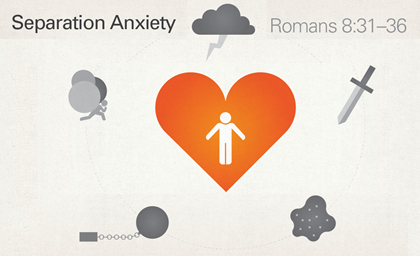
Separation Anxiety: Can anything separate us from the
love of God? Paul lists potential barriers before triumphantly declaring that
nothing can separate us from God.
Affliction,
distress, persecution, hunger and need, danger: All of these are natural
consequences of life in a yet-to-be-fully-redeemed world, but they have no
bearing whatsoever on God’s favor and love for us. No matter the circumstances,
despite how we might feel, we must steadfastly rest in the truth that God is
with us and for us. Nothing can separate us from His love.
In
fact, rather than the trials and opposition overcoming us or separating us from
the love of Christ, the opposite is true. In 8:37 Paul makes the audacious
claim that we prevail—that we are more than conquerors. How can this be? It is
not because the trials and suffering disappear in the short term; they don’t
and won’t. Rather, Paul’s claim is based on the bigger picture outlined in
Romans 8. All things work together for good—not by avoiding the hardships—but
by God guiding all things to accomplish His purposes. Since nothing can
separate us from the love of God, and since no one can make an accusation stick
against one of God’s elect, the short term doesn’t matter. We may suffer, be
imprisoned, even be killed. But the God who was faithful enough to us to send
His only Son will remain committed to finishing the job. Present battles
indicate nothing about the overall war. God has already won—it is simply a
matter of faithfully following Him as He does what He has promised—working all
things together for good according to His larger plan. So when you feel tempted
to be anxious about your status with God, instead remember the bigger picture.